1. SEO Beyond Traffic and Visibility
Search Engine Optimization is widely understood as synonymous with increasing website traffic, but traffic alone does not deliver business growth. What counts are the particular prospects you attract, and whether they are prepared to act or not. This is the aim of lead generation SEO to bring together these two levels so that search visibility reaches its business, on target.
When SEO is merely thought of as getting a good place in the rankings, it will usually draw people who read and go away without taking any further action. However, if we focus on getting leads then this changes. We specifically choose searches like this where users want to do or know something. These searchers will not come from people who simply want general information but rather to perform something from experts in the field or avail themselves of services that we provide.
With a focus on lead generation, SEO becomes a growth channel rather than an end in itself. It allows businesses to attract qualified prospects, reduce their dependence on ads and achieves predictability by providing a steady stream of opportunities from organic search. This approach transforms organic search into something that can be measured and continually improved over time, ultimately producing leads of quality.
2. What Lead Generation SEO Really Means
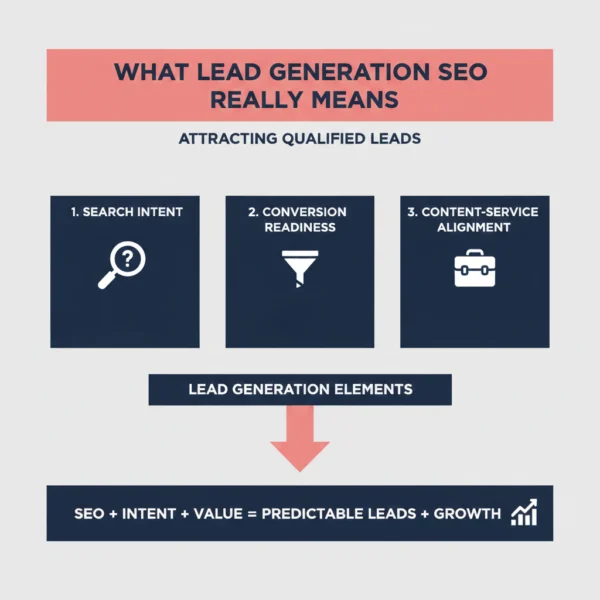
Lead generation SEO is the practice of optimizing a website to attract visitors that are likely to become leads rather than just increasing traffic volume. It is conceived in terms by focusing on search intent, converting readiness and aligning content with the business service or solution being offered.
Unlike traditional SEO, which tends to focus on rankings and impressions, lead focused SEO aims for results. The aim is to guide users from search results towards actions in line with what we are asking them to do. This needs a richer understanding of what prospective customers are looking for and why.
Lead generation SEO combines a number of different elements. Keyword research targets searches driven by problems. Content responds to actual wants and concerns in detail. Technical structure means that pages load rapidly and perform smoothly. Conversion processes make it easy for people who visit the site to take further steps of their own choice.
When these elements work together, SEO becomes a predictable source of qualified leads. The site does not just get the largest number of users possible, but rather attracts visitors who are looking to solve specific problems.
3. How Search Intent Drives Qualified Leads
Search intent is crucial because it prepares lead generation SEO. This is because the different types of queries in this case also represent different stages of readiness. Some users are simply looking to learn about something, while others are searching specifically for a solution or service.
Lead focused SEO therefore looks to target the intent that signals potential action. When content matches what users are actually looking for, then both the quality and quantity of traffic trends upwards with more stable lead volume as a result.
Informational Intent
Informational searches generally come from users seeking answers or guidance. These kinds of searches often ask questions, provide reasons and methods, etc. Although they are less likely to convert immediately, they do introduce your business and establish trust within the decision-making process by helping its customers get informed and avoid making any major mistakes later on.
Informational intent examples include:
- Questions about common problems
- Searches for explanations or definitions
- Requests for tips and best practices
Through such informational content, users who get educated are guided along the path to increased engagement, ready for later lead generation.
Commercial Intent
Simply put, commercial intent means that a user is either looking at various options or evaluating solutions. In a web search, these often contain words relating to services or comparisons, as mentioned below. Such people are currently at a stage where they are likely to turn into customers and should be treated accordingly.
Commercial intent searches typically involve:
- Service comparisons
- Best option searches
- Pricing or feature related queries
In addition, attracting these searches is rather straightforward.
Transactional Intent
The purpose of a transactional search is to take action. It is clear that these searchers want to get in touch with a provider, ask for a quote or firm up a decision. It is this lethality that is the main aim in lead generation SEO.
Transactional intent frequently takes the following form:
- Searches specially for services
- Queries based on a specific location
- Contact or consultation-related words
If pages are optimized for transactional intent, SEO is no longer a process that leads to lump-free traffic. It becomes the least indirect of all in producing leads. Understanding the intentions behind search queries allows firms to better match content, keywords and paths of conversion.
4. Why Traditional SEO Fails Without a Lead Focus
Traditional SEO has usually meant focusing on rankings, impressions and traffic volume. They look great on reports, but that doesn’t mean they necessarily lead to real business growth. Thousands of users can be attracted to a Website without generating a single lead. This gap appears when SEO fails to produce any form of customer behaviour.
When made up entirely from high volume keywords SEO just attracts people who are browsing or still in the research phase. Transactions are not completed, but information is taken. The traffic mounts and salespeople are still seeing no increase in inquiries or opportunities.
Chapter-oriented SEO solves this problem. We align optimization with the company’s business goals. Web pages are built to solve specific points and guide users through clear next stages. Keywords are selected based on meaning rather than mere popularity. Content is arranged so that it aids decision-making rather than just shows up in visible results.
Without this emphasis, SEO is at best an aid to awareness. With it, SEO becomes a predictable course for lead generation.
5. Content That Attracts and Converts Leads
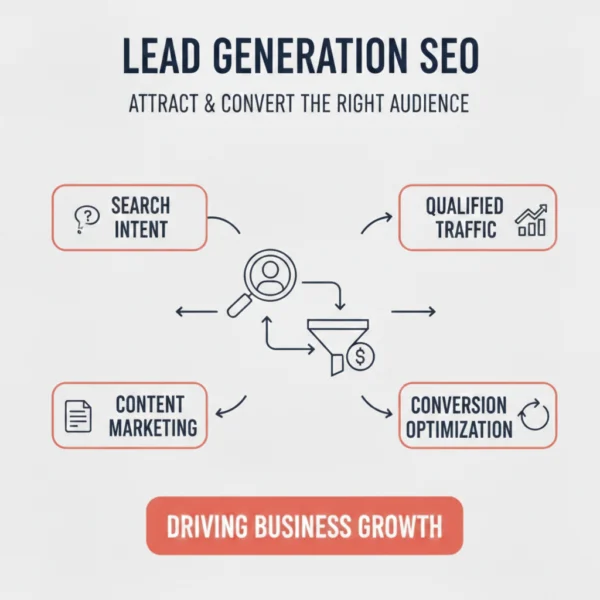
The transition from search visibility to lobbying. Ranking alone does not lead to generating leads. The content must guide their visitors to understand the service value and take their next steps in purchasing decisions. SEO practitioners who focus on leads put the emphasis on content that helps people towards decision-making and away from simply looking in a passive manner.
Service Pages Built for Intent
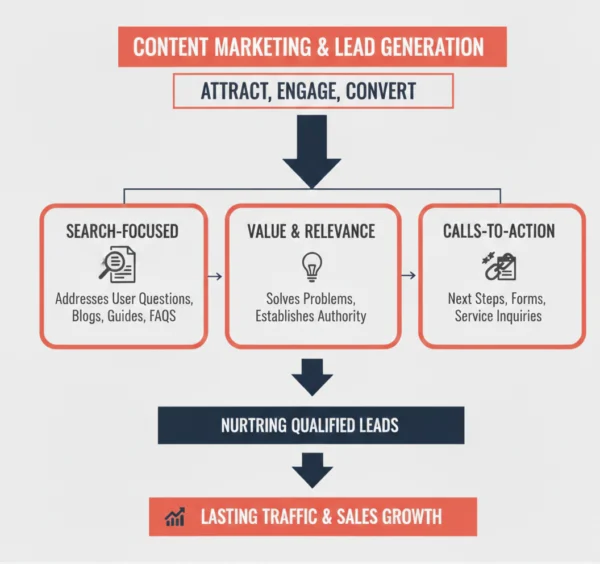
Service Pages are often the most powerful driver of leads. These pages should clearly state what the company offers, who they help and how they will solve specific problems. When service pages are geared in search intent, they draw users who’re actively looking for solutions.
High-converting service pages will focus on:
- Clear explanation of the service
- Problems the service addresses
- Benefits and outcomes rather than features
- Simple and visible conversion paths
Landing Pages Designed for Conversion
While general pages feature a mix of goals, landing pages concentrate on one. They strip away distractions and guide visitors toward a single clear action.
A good lead focused landing page might contain several of the following:
- A clear message that matches the search query
- Focused content without unnecessary navigation
- Trust signals such as testimonials or credentials
- Straightforward forms or contact options
Educational Content That Builds Trust
Educational content aids the generation of leads by answering questions which people have before they contact a business. User guides, pieces of writing and explanations not only attract criticism, but also provide credibility. Such content naturally linked back to service pages helps persuade people from learning into actions. Content that attracts leads is much more than just ranking. It informs, comforts and guides.
6. Role of Keywords in Lead Focused SEO
Keywords are what determine whether someone finds a website or not and why they arrived there. In lead SEO, keyword selection is not merely about volume alone: it’s about intent, relevance, and willingness to act. The right keywords bring in visitors who are already looking for answers instead of just general information.
Problem Based Keywords
Problem-based keywords reflect those issues users want to solve. They’re used by people who know there’s a problem but are still seeking solutions. Targeting these keywords early introduces the business into users’ decision process.
Problem-based searches include typical:
- Questions about specific challenges
- Searches describing symptoms or issues
- Queries focused on fixing or improving something
Content using these keywords casts the business in that light and builds trust before any sales conversation gets underway.
Solution Driven Keywords
This kind of key word shows more direct intention. People using solution keywords are actively seeking services, providers or methods with which to resolve their problems. Optimizing for these key words puts us closer to users on the brink of becoming leads.
Solution-based searches tend to include typical:
- Service specific terms
- Industry related solutions
- Searches comparing providers or approaches
These keywords are essential for service pages and landing pages that focus on conversions.
Balancing Volume and Intent
High-volume keywords may look attractive, but they often attract poor-quality traffic. Lead SEO does not target keywords with big volume numbers. Instead, it looks for clear user intention, and though these searches may have lower traffic numbers they convert more frequently. And they lead to more significant business results. By aligning key words with real user needs, SEO brings in visitors who are ready to engage.
7. Technical SEO and Conversion Readiness
Technical SEO is closely linked to lead generation, since whether visitors can interact with a site smoothly largely depends on it. No matter how much you target traffic, pages that load slowly or don’t load at all will cause visitors to fall away. The same is true for forms that don’t work and bad navigation. SEO that targets conversions requires a site that can do things technically and practically.
Fast-loading pages increase engagement and reduce abandonment. Users searching for services often compare multiple services almost immediately. If a site takes too long to load it can cause potential leads to leave before they have even gotten started. Technical optimization ensures pages react quickly on all devices and browsers.
Mobile usability is equally important. Many searches for a service come from a mobile device. On smaller screens forms, buttons, and navigation should all work right. A bad mobile experience has a direct effect on lead volume whatever the rankings.
It is also easy for technical SEO to build clear conversion paths. A clean site structure makes it easier for users to find contact pages, services information, and next steps with no confusion. Search engines benefit from this structure as well, making it easier for them to know which pages are designed to generate leads.
When technical SEO supports performance, usability, and accessibility it turns traffic into something very valuable indeed. Visitors can move from interest through action without any obstacles.
8. Local SEO as a Powerful Lead Generation Driver
Local SEO is a big factor in lead generation for businesses that serve specific geographical areas. Many users look for services with the intent of certain locations, especially once they are about to contact someone. To optimize local search helps catch these high intent leads at just the right point.
Local search often includes location names, service types and phrases indicating proximity. When a business shows up for such searches it has gained visibility among users who are actively looking to immediately fulfill their needs. This makes local SEO one of the biggest sources to strongly produce qualified leads.
The local SEO topics that support lead generation are:
- A complete and accurate business listing
- Location- specific service pages
- Business information is uniform in the directories
- Reviews that enhance trust and credibility
Local SEO also increases visibility within map results, which converts users who are ready to pick up the phone or visit a store or make an appointment. These users generally convert faster than those who are still in the research stage. For service-based businesses, local SEO transforms organic search into a direct source of inquiries.
9. Measuring SEO Success Through Leads Instead of Rankings
For outcomes, lead generation by SEO needs to be evaluated. Rankings and traffic can provide context, but that does not imply SEO is contributing to business development. Measuring success through leads helps determine whether organic search has real value or not.
As traditional SEO reporting often focuses on impressions and positions for keywords. These metrics show reach, but they do not indicate performance at the business level. Measurement geared around leads connects directly into inquiries, conversations and opportunities rather than being tangential to them.
Key Metrics Reflecting Lead Generation Performance:
- The most useful indicators quantify user actions, not page views.
- Form submissions arising from organic traffic
- Calls made via search results
- Contact page visits from search traffic
- Conversion rate of organic sessions
- Lead quality and follow up outcomes
Tracking these indicators allows us to better understand the role of SEO in sales and service pipelines.
Traffic Versus Leads Comparison
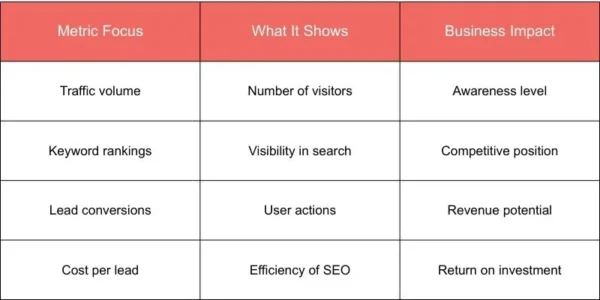
This comparison emphasizes how lead–oriented metrics provide more insight than rankings alone.
Using Data to Improve Lead Quality
SEO data needs serve as a guide for improvement. Pages that draw traffic but few leads may need more lucid messages or stronger calls to action. Keywords yielding conversions should be bolstered by secondary topics and their associated pages.
When SEO success is measured in leads, strategy becomes more cohesive and predictable. This method makes organic search into a channel of measurable growth rather than just something to report on.
10. Conclusion:
The distinction between visibility tactics and a predictable method for organic search can be seen in the effective combination of intent, conversion readiness, and actual outcomes. SEO attracts visitors who are already looking for answers. They’re not casual browsers.
When keyword strategy, content, technical structure of the website and local optimization are combined, SEO will give you consistent leads over time as well. This approach both lessens dependence on paid advertising and in its stead creates more stable opportunity flows. Rather than chasing short term traffic spikes, brands are busy building long term authority and trust.
SEO truly becomes valuable when success is measured in leads, not just rankings. Pages are optimized for users to take action and performance is measured by actual engagement. This alignment makes organic search provided directly to revenue and growth goals.
Lead generation SEO is not an option for businesses that need sustainable results. It’s an investment that offers a long-term payoff in visibility, durability, and predictable lead flow.
Are you struggling to get more traffic?
Run a free SEO analysis to uncover site issues, competitor gaps, and ranking opportunities.