1. Why SEO Matters for Shopify Stores
Shopify makes it easy to start an online store, but simply starting such a store is no guarantee of prominence. Thousands of Shopify stores clamor for visibility. Most customers prefer to do their shopping via Google. It is within this context that the basic idea of search engine optimization comes into play.
In order to attract visitors from consumers who are actively searching for products, SEO can guide a store to better visibility. Spreading the word only by means of ads and social media, as we have done for too long, allows for but a single bolus of customers. Those who visited came as a result little else than a quarantined manner of broadcasting. These visitors are not browsing idly. They are looking for something specific: products, comparisons, solutions.
For store owners, the purpose of SEO is not just to rank higher and grab more clicks–it is for sustainable development. It makes a store less reliant on paid advertising, and helps build credibility with search engines and human visitors. If done right, a Shopify store becomes easier to find, easier to trust, and easier to grow.
2. Why Shopify Stores Need SEO to Compete on Google
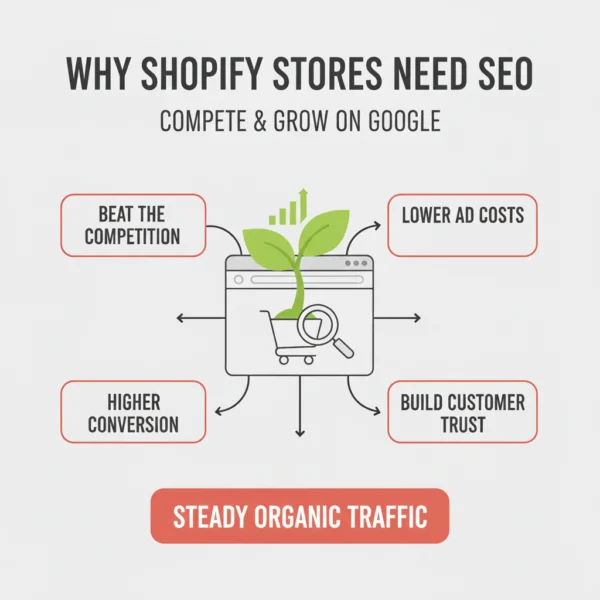
Although Shopify has simplified the process of opening an online store, the lower the barriers to entry the more the competition. There are thousands of stores selling bonsai trees, many of them filled with identical products and templates. Without SEO, a Shopify store must generate almost all its traffic through paid ads or social networks. This method is both costly and unstable in long haul operation.
SEO will help a Shopify store compete organically, appearing in search results where people are actively looking for products. A store that turns up in response to standard searches will attract visitors with clear intent. These particular surfers are already looking for products. If they come via a targeted user group, then chances of conversion are much higher.
Search engines also reward stores that provide hot content, organically structured solutions, and a brisk pace. A Shopify store that only lists products without making them search engine friendly will struggle to stand out. SEO helps search engines understand what the store sells, who it’s targeted at, and why it should rank higher than its rivals.
For those Shopify businesses who want to keep growing with a little effort, SEO pulls dependence upon ads, increases trust and brings a steady stream of targeted visitors.
3. Keyword Research for Shopify Stores
The foundation of effective SEO for a Shopify store is keyword research. It can help you spot what potential customers are looking for and then choose the best way to position your products around these needs. Without the best keywords on board, even a well designed store has trouble attracting qualified traffic.
3.1 Understanding Buyer Intent
Not all keyword searches end in a purchase. For Shopify stores, keywords that show buying intent work best. These searches will typically include product names, categories and materials, or have specific use cases in mind. Understanding intent helps focus on visitors who are closer to making a decision rather than those only browsing.
3.2 Finding Product Focused Keywords
Effective Shopify keyword research is about the areas that directly influence sales.
- Product specific keywords aimed at individual items
- Category keywords describing collections
- Problem based searches for products that solve this problem
- Comparison and alternative searches
These types of keywords align store pages with real customer needs.
3.3 Using Keywords Across the Store
Once they have been located, your keywords need to be placed naturally across the Shopify store. That includes product titles, descriptions, collection pages and images. But it also means that supporting text too must carry those words. The goal here is clarity not repetition. Search engines should understand easily what each page is about and who it serves.
4. On Page SEO Optimization for Shopify Stores
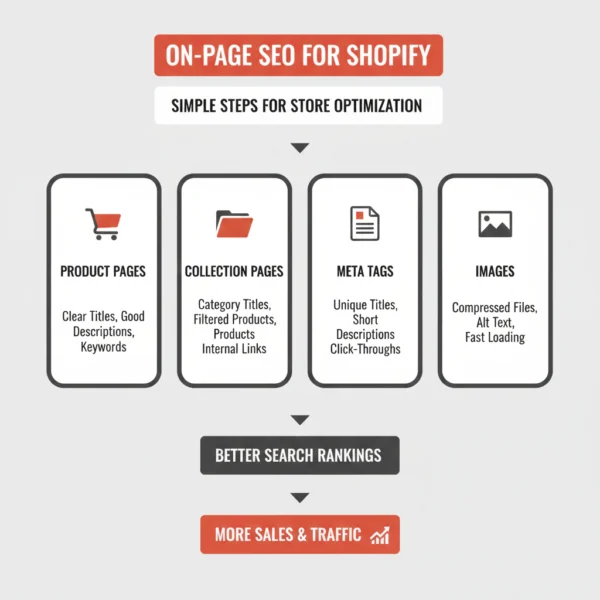
On page SEO is about making search engines like Google and Yahoo can understand what the store has to offer through the optimization of individual store content and structure. For Shopify stores, this step is crucial because product and collection pages directly affect rankings and conversions.
4.1 Optimizing Product Pages for Search Intent
The product page needs to match exactly what users are searching for. This starts with clear product titles that describe the item naturally rather than stuffing keywords in there; a good description should also explain benefits, usage, important details and answer buyer questions in a way conducive to search engine visibility.
- Detailed product descriptions written for users
- Clear and descriptive titles for products
- Logical use of keywords within natural language
- Page structure that is clean, and readable
If content answers real buyer questions, search engines reward it with better visibility.
4.2 Improving Collection Pages for Category Rankings
Collection pages help Shopify stores rank for broader category searches. These pages should not rely only on product listings. Adding short introductory content helps explain what the collection includes and who it is for.
Effective collection pages usually contain:
- A clear collection title
- A short explanation of the product category
- Organized product sorting
- Consistent internal linking to related collections
This improves both user navigation and search engine understanding.
4.3 Meta Titles and Meta Descriptions
Meta titles and descriptions play a major role in attracting clicks from search results. Each Shopify page should have a unique title and description which accurately reflect its content.
Strong meta elements typically:
- Accurately describe a page
- Include relevant search terms naturally
- Encourage users to click through without being deceptive
- Higher click rates often lead to better long term rankings
4.4 Optimizing Images for Better Performance
Images are essential for Shopify stores, but they must be optimized properly. Large image files can slow down pages and affect rankings. Optimization of images includes compressing the files, using descriptive file names, and adding alt text that describes what is in an image.
Optimized images improve:
- Page loading speed
- Accessibility
- Image search visibility
By using on page SEO, Shopify stores can establish a strong foundation from which to operate.
5. Content Optimization That Matches Search Intent
How Shopify shops compete in Google is heavily influenced by content. Pages that answer a user’s question clearly and provide helpful knowledge are more likely to be prioritized by search engines. When content matches search intent, it makes it easier for Google to understand the page and rank it under the right keywords.
5.1 Optimizing Product Descriptions for Search and Conversions
Product descriptions should speak about more than just features. They should be structured to articulate value clearly and tend to focus on themes such as lifestyle or pain broth. The first step to optimizing your product page is to make the product name and description fully focused on the intended keyword or long-tail keyword.
Effective product content focuses on:
- Clear explanation of what the product is
- Practical benefits instead of generic claims
- Natural use of relevant keywords
- Scannable structure that is easy to read
This balance supports both visibility and conversions.
5.2 Creating Collection Pages That Target Broader Keywords
Product collection pages may be optimized for keywords in the header tags, descriptions, beginnings of paragraphs, or wherever necessary. Results from pages developed using this toolkit have tended to be ahead of their organic traffic, as it happens. Strong collection content is crucial for informing Google of relationships between products and why the shopper would want to visit a page arraying different types of products.
5.3 Using Informational Content to Support Product Pages
Pre-sales questions are what gives blog content added value to Shopify. Guides, analysis pieces, how-to articles and other user-oriented content all attract users earlier in the buying cycle to their product sites, and they can also link internally between categories. Both of these benefits are important for SEO on Shopify. When content matches users’ searches, the quality of traffic increases and rankings remain stable over time.
6. Content and Blogging That Strengthens Shopify SEO
Content plays a major part in helping a store like Shopify reach higher in Google rankings. While your product pages are on transactional search keywords and cover transactions, content appeals to best ways of doing it. This way, customers get ahead in the purchase cycle before they are ready to buy.
Stores that provide useful answers to common questions in their industry are rewarded by search engines.
6.1 Blog Content That Attracts Qualified Traffic
Shopify blogs help to bring search traffic from people in the market for products, evaluations, and ‘blueprint’ type solutions. A good blog post can bring visitors who are much more likely then later on to actually convert.
Effective blog topics include:
- Product comparisons and buying guides
- How to use or maintain products
- Problem solving content related to the product category
- Educational content that explains features and benefits
This type of content supports long term organic growth and feeds traffic into product pages through internal linking.
6.2 Content That Supports Product Pages
Content is always part of product pages. Blogs should guide readers naturally on to the relevant collections or products. This improves internal linking, while at the same time allowing search engines to understand inter-relationships between pages.
When content matches product intent closely, it strengthens ranking signals and enhances the chances of conversion.
6.3 Building Topical Authority for the Store
Constant content about a specific niche domain helps Google trust the store to be a reliable source. This in turn makes it easier for both blog posts and product pages to earn top search spots over time.
Content-driven SEO supports regular growth in site traffic rather than sporadic peaks. It also reduces dependence on paid advertising by building up long-term, organic visibility.
7. Content Marketing and Blogging for Shopify SEO Growth
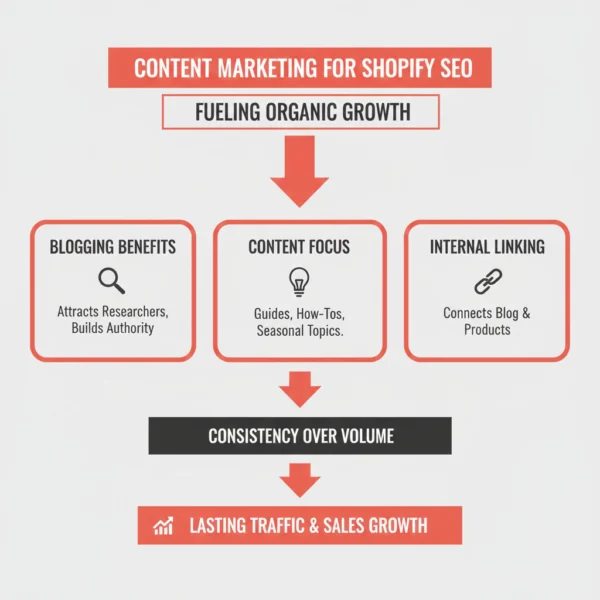
In the world of search, content plays a decisive role in raising the visibility of Shopify stores. What is made available to customers at the product pages signifies a transaction from them to a company; whereas blog content caters to information needs before passage has been set up and during it This combined approach strengthens both united visibility and strength.
How Blogging Supports Shopify SEO
Well written blog content helps a Shopify store in several ways.
- Targets long tail keywords related to products and use cases
- Attracts users who are researching before purchasing
- Builds topical relevance around product categories
- Creates natural internal linking opportunities
- Earns backlinks over time
When content truly answers customers’ real questions, Google sees that shop as more useful and trustworthy.
Types of Blog Content That Perform Well
Not all blog entries bring in results. The more successful types of Shopify content usually focus on:
- Guides to help customers buy
- Comparisons between types or features
- How to use and maintain items
- Problem solving related to customer pain points
- Seasonal content matching shopping intent
Each article should link naturally to relevant products or collections.
Internal Linking Between Blogs and Products
Blogs should not float in space. Strategic internal linking strengthens SEO and makes navigation better.
- Blog posts should link to suitable product pages
- Product pages can link back to supporting blog content
- Category pages should reference educational articles
This structure helps search engines to understand the relationship between parts of the site and makes users stick around for longer periods.
Consistency Over Volume
It is consistency in posting that really counts. Even one high quality blog post per month can bring results if it is well optimized and responding to search intent.
Compared with what he gets from paid ads, content marketing can help a Shopify merchant grow towards lasting traffic that consistently brings in sales over time. The next section shows how link building and brand prestige further boost Shopify SEO power.
8. Measuring SEO Performance for a Shopify Store
Frequent observation of what’s working and what isn’t actually makes SEO work. Better measurement means that a Shopify store can capture what it is that works, what doesn’t, and also where opportunities for growth may lie. Smart measurement based on the right data puts paid to suppositions and helps make smarter decisions over a period.
8.1 Key SEO Metrics Shopify Store Owners Should Monitor
Several key indicators, if followed, provide a crystal clear vision of the progress made in SEO.
- Organic traffic from search engines
- Keyword ranking on product and collection pages
- Click through rate in search results
- Conversion rate among organic visitors
- Indexed pages within Google Search Console
These indicators show both visibility and business impact.
8.2 Understanding Traffic Quality, Not Just Volume
The high traffic by itself doesn’t amount to anything more than people clicking on site links. What counts is what happens when people arrive at your shop. If they’re browsing your products, looking at collections and eventually buying something there, then all your SEO efforts succeeded in getting the right audience. Poor engagement often means there’s a breakdown between search intent and page content on your site.
8.3 Using Shopify and Google Tools Together
Shopify analytics gives sales and customer behavior results, while Google Search Console and Google Analytics inform how users are coming to the site. Recent work combining the results from both these tools reveals clearer patterns. Having seen these combined results, you can now see which pages bring in money and where improvements might be made.
8.4 Making SEO Adjustments Based on Data
SEO suffers from incremental adjustments. Pages that rank but don’t convert may need clearer content or better product presentation in time. Keywords that bring many impressions will lead to more clicks if they have stronger titles and descriptions. These small adjustments eventually lead to much stronger long term performance. Continuous measurement changes SEO from a guessing game into a controlled growth channel.
9. Tracking SEO Performance for Shopify Stores
SEO results shown lately are as long term goodwill. Therefore, we must keep on measuring its performances and modifying our methods in time if necessary. For Shopify stores, tracking the correct data, how to say this more politely? helps identify what is working, what needs to improve and where growth opportunities might exist. If we don’t monitor performance, SEO remains unaccomplished.
Key Metrics That Matter for Shopify SEO
Shopify store owners need to concentrate on a small set of meaningful indicators, rather than try and track everything.
- Growth of organic traffic from search engines
- Keyword rank improvements on product and collection pages
- Google search result click through rate
- Conversion rate from organic visitors
- Revenue generated by organic search
These metrics connect SEO activity directly to business results and not only surface level display.
9.1 Understanding Search Console and Analytics Together
Google Search Console indicates how a Shopify store displays in search results. The display includes impressions, clicks, search terms entered into Google and technical problems. Google Analytics meanwhile can show what happened after users arrived at the store. Only when both these are considered together can we see a complete picture of performance. This combination helps identify pages that attract traffic yet do not convert, also pages which convert well but need to be more visible.
9.2 Using Data to Improve Store Performance
SEO data must guide decisions. If a certain product page received traffic but had low engagement, we might need to change the content or layout there. If one collection page ranked and produced a few clicks, it could be that we would have to revise its meta titles or descriptions.
Regular reviews can help Shopify stores refine their content outlook, improve technical performance, strengthen their tracking of keywords and so on. All this kind of work will in time lead to consistently higher traffic quality, a more regular revenue stream and more stable earnings.
By tracking performances we make sure that SEO remains in line with the business’s aims and continues to deliver long term value.
Conclusion:
By employing SEO, Shopify stores can develop sustainably without having to rely solely on paid ads or promotions in a momentary craze. When properly implemented this raises visibility, burnishes search-engine trust, and forces active shopping consumers into the store. This type of traffic is much more pertinent and conversions are more stable.
Solid Shopify SEO begins with a store that is technically healthy, has clear page structure, optimized collection and product pages as well as content that meets real consumer needs. These factors serve to help search engines better understand your shop and make navigation more convenient for users. Ultimately, this creates a smoother shopping experience and stronger search rankings on the results pages.
Unlike paid campaigns, SEO does not stop producing results with the end of your budget. Instead, each optimization serves to bolster the store’s foundation, ensuring long-term growth. For Shopify businesses seeking stability, credibility, and sustainable sales, SEO is still an effective marketing strategy.
Are you struggling to get more traffic?
Run a free SEO analysis to uncover site issues, competitor gaps, and ranking opportunities.