1. Why Off-Page SEO Matters for Website Authority
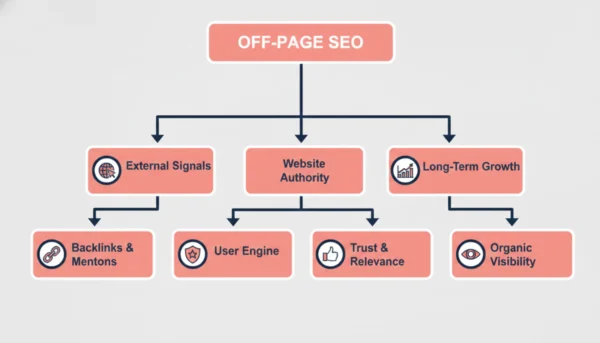
Off-page SEO is crucial in how search engines interpret a website’s trust and authority. While the on page and technical SEO focuses on what within the site itself, will get promoted to others. We might say off page seo focuses on how the rest of the Internet responds to your website. Search engines take in these external signals as indicia of trustworthiness, relevance and reliability.
Websites that get attention from other secure sources are probably going to be ranked higher on the search engine results pages. These signals help search engines understand whether a website is known, referred to and respected within its industry. Without off-page SEO, even well structured websites rich in but that content may struggle to compete in hard-fought search environments.
Off-page SEO isn’t about shortcuts or instant visibility. It’s about creating a good reputation that fortifies over time. When done well, it builds authority and visibility for the long-term organic growth of your industry.
2. Understanding Website Authority and Why It Matters
Website authority refers to the trustworthiness and reliability in the alignment of a web site It is built over time through the signals that display credibility, relevance, and awareness across the web. Authority is bland and uncertain when you are building your website. Search engines employ authority as a criterion to decide which websites are worthy of higher visibility for a given search query.
A site with good authority is more likely to rank consistently, even in competitive industries. It also will be indexed more quickly, given more opportunities to crawl up and down the site when there are changes, and less without cause for ranking fluctuations. Authority is not an immediate thing that can be achieved. Instead, it is built by many external signals working together.
Off-page SEO is at the heart of building this authority. When other reputable sites mention, reference, or link to a site, it is a strong signal that the content is valuable not only on its own platform. Such signals tell search engines that the web site is recognized and trusted within its field.
Understanding authority sets the stage for discussing how off-page SEO works in practice. The remainder of this section explains core elements which we will focus on in this book, and how those parts contribute towards building authority.
3. Why Authority Matters More Than Ever in SEO
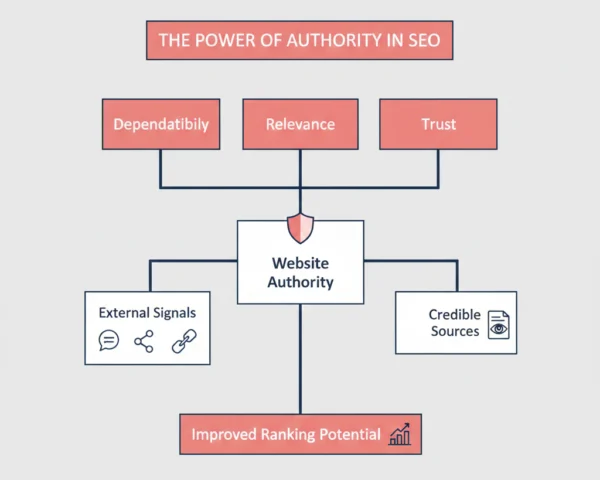
Search engines are concerned with showing their customers who they could depend on. On the world-wide web, authority decides which websites are given top priority. If a site is seen as authoritative, it sends signals of dependability, relevancy and trust within its own area.
Authority is not created by the publication of content alone. There are many sites which produce good content but only a few are recognized by other trusted voices. Search engines use these external signals to understand which websites are popular in all directions across the web. A site which is mentioned, referred to and linked by other credible sources of information is more likely to come up higher.
In competitive businesses, authority is often the difference between victory and defeat. Two websites may both set their sights on the same keywords and be after the same kinds of information, but off page signals will count for more. Authority eliminates confusion for search engines. It confirms that the website is not an island and that others find its content valuable enough to reference.
These external trust signals can, directly, affect authority, and therefore off page SEO helps to build it. It becomes more trustworthy itself every time one quality mention or backlink goes to the development of an individual page. Each page now has improved ranking potential over time: instead of just one keyword, it can cover the area of rankings for all connected pages of a site.
4. The Role of Quality Backlinks in Building Authority
Backlinks are still one of the strongest signals for Google and other search engines to assess website authority. A backlink is akin to an introduction from another site, telling you the content it points to is credible, helpful or dependable. When these links are from qualified and sympathetic sources, search engines change their assessment of your web site.
The important issue is quality, rather than number. A handful of links from authoritative websites in the same industry will make more of an impact than dozens of links from unrelated or unqualified sources. Search engines assess where the link comes from, how relevant the linking page is, and whether the link appears natural within the content.
Authoritative backlinks are advantageous in a number of ways. Building trust signals and raising crawl frequency for instance can help to build higher rankings on competitive keywords. Getting your site in front of a fresh audience can also be good for natural mentions as well as one new backlink over time and increase the natural link trump.
Off-page SEO stresses building up backlinks by means of good content, a strong brand identity and authentic relationships rather than artificial methods. When backlinks demonstrate true credibility, bit by bit your authority increases and ranks stabilize.
5. Brand Mentions and Citations Build Trust Beyond Links
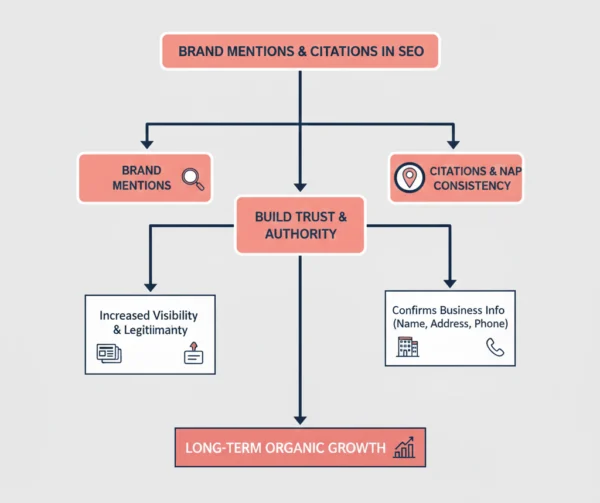
Off-page SEO is not about linking back only; search engines also judge how well a word appears on the Net. When a company’s name shows up here and there even without an active link being present, these mentions of the brand are votes for legitimacy.
When a company’s name is consistently seen on respected sites, search engines take it as a flag of quality. Mentions in industry blogs, news sites, directories, forums and review platforms all figure into this broader trust profile.
Citations play a crucial role on both local and non local sites. Unified business information broadcast over all listing services is something which search engines can in fact verify. And from the point of view of trust, consistency is important: a business name that matches the address and contact numbers reduces confusion and strengthens authority signals.
Off-page SEO reaches best expression with mutual support between links, brand mentions, and citations. Taken together, they are what search engines use to determine if a site is active, reliable, and pertinent within its sphere of interest.
6. Social Signals and Brand Visibility
Posting things to Google plus social platform regularly won’t lift a website’s page rank. Individuals increase visibility and brand recognition by sharing commentating content on social platforms, even earning more traffic from those views in the long run.
A strong social presence means content can get out of search results. Where people engage with posts, share articles or mention your brand in discussions this ranges your audience to new groups. It makes it more likely that bloggers, publishers and sites dealing with industry news will be exposed to your content then link back for you there.
Brand awareness is a cornerstone element of trust as well. When a business appears continually across social media platforms search engines will associate the name with authorized identity and relevance to today’s world. Even mere mentions will reinforce influence or authenticity just like direct links would, though they don’t seem to have any hand in how much authority a company possesses.
When social activity supports content distribution powerfully instead of simply functioning as a solitary endeavor for SEO on page, off page benefits. Social sharing and brand mentions, content promotion and even user activities work together to build overall authority at this stage. Rank’s will again begin going up slightly more as these connections gather force over time. Ranking algorithms return better-paying customers into the mix where they’ve sensed legitimacy higher levels of quality and stronger brands.
7. How Off Page SEO Builds Long Term Trust and Authority
Over time, the role of off page SEO is to shape search engines and users’ perception of a website. Creating a brand of visibility, trust and interaction is the “core idea” underpinning what we’re doing.
Enforcing a reputation is hardly a matter of instantaneous transformation. Rather consistency in strength and significance on all points: hard work then repays later. All web pages have a domain authority, and once that becomes evident over time with consistently received signals of credibility and trust, externally linked websites will need it. Adding your web page to a directory listing nowhere on the Internet had links but here is such bad luck for most businesses.
Also off page SEO serves to raise brand profile. When a brand is seen on respected platforms, blogs, directories and publications more often, people inevitably become more familiar with it. The more familiar people are with something then the greater is their trust in both nameless ranking algorithms as well as what user conduct would leave a trail itself.
Unlike short- term tactics, off page SEO has a longer scale of influence. Long after being made links or being talked about, links and discussions continue to sustain authority. This lasting value makes off page SEO a cornerstone to enduring search presence rather than merely temporarily raising your ranking in a few days’ time.
With trust and authority in place, the website’s rankings rise and it becomes more impervious to the slings and arrows of search engines’ ever-changing algorithms.
8. Social Signals and Brand Mentions
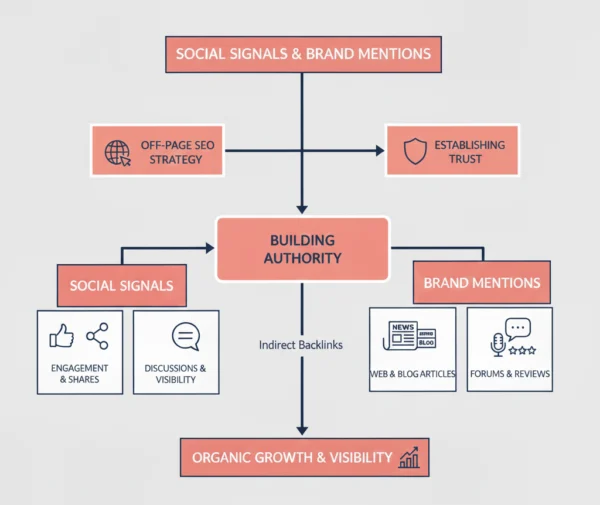
Link building isn’t the only off-site seo strategy. The use of brand mentions and social signals is also essential for establishing authority. If a brand is mentioned repeatedly on websites, search engines will identify it as a tangible and ongoing concern.
Brand mentions occur when a website, blog, forum and social platform refer to a business name without necessarily including a hyperlink. These mentions help to reinforce a brand’s credibility and visibility. Over time, in your trade, standard mentions across relevant platforms mean recognition and trust.
Social network activity contributes indirectly to off-page SEO. Although social links may not give any direct ranking value, content that is popular on social media will often receive natural back links. Shares, discussions and engagement lift the visibility of content, leading to more opportunities for authoritative sites referring to it.
A strong off-site plan relies on encouraging organic brand conversations, creating content that is so share worthy it puts Tokyo taxis to shame, and maintaining a presence where your audience already hangs out. These efforts go beyond conventional link-building tactics and help build authority.
9. Measuring the Impact of Off Page SEO
In order to better comprehend whether it is building authority and moving results, off-page SEO activities need measurements. Although off-page aspects proceed tentatively, they may make a striking impact as correct signals continually monitored can testify.
Probably the best indicator is organic ranking improvement. When links of authority and brand mentions increase, search engines reflect greater confidence in your company. This often, usually means improved visibility on competitive keywords and better placement over time for your marketing products.
Referral traffic is another key indicator. Quality links bring people to your site from relevant sites that trust the source already. When referral traffic increases and its behavior indicates high engagement levels, it shows you’re undergirded on meaningful platforms rather than worthless sources.
Brand mentions and search demand are also informative. When more and more people are seeking the name of your company or referring it to others through different channels, then this represents a growing authority and recognition in society which feeds back again into visibility and marketing performance metrics directly closer to home.
Finally, domain authority trends in general are an overall measure of progress. Although not an immediate ranking factor, steady increases in authority scores over time typically correspond with stronger links profile and healthier off-page signals.
Collectively, tracking these points provides a rounded picture of how off-page SEO contributes to growth. If you measure off page activities correctly that will make them more targeted, more strategic, and more successful over time.
10. Conclusion:
The function of Off-page SEO in search engines is crucial to the evaluation of trust, credibility and authority. Although technical improvements and on page factors provide a solid base for success, off-page signals indicate to what extent a website is known and appreciated outside of its own domain. These signals give search engines information as to which sites should be put into greater prominence.
A consistent strategy of off page work strengthens your brand’s presence, while referral traffic grows and supports ranking stability over the long term. Genuine brand mentions, quality back-links, positive word of mouth and keeping those reviews all add to this. Taking the long view in other words it is possible to establish just such a natural authority over time through cooperation among websites with aboveboard contents.
While short-term tactics may get you through the day when combined with good on-page structure and technical health, off-page SEO turns bits of metal into one great sword for long-term benefit: sustainable growth coupled with competitive advantage.
Are you struggling to get more traffic?
Run a free SEO analysis to uncover site issues, competitor gaps, and ranking opportunities.