1. Why SEO Is a Sales Channel for E-commerce, Not Just Traffic
Many e-commerce businesses consider SEO as a way to increase traffic, maybe that will bring more visitors to their website. Traffic is progressing however, by itself it cannot pay the bills. The key issue is really whether or not the number of hits converts into customers for you.
In this respect, ecommerce SEO stands in contrast to ordinary search engine optimization. When done properly, it is based around buying intent. It seeks to identify and draw in people who are already considering purchasing a product, comparing alternative brands to theirs, or readying themselves for the final stage of buy-below each of its pages not only captures but holds visitors within that group which are looking for solutions they actually want to pay for.
SEO also promotes the buying process as a whole. From how products are discovered, to how categories are organized, and all else in between for that matter, every decision that you make about your website ranking in search engines will affect whether or not visitors convert into customers. When these parts work together well, SEO becomes a substantial part of your sales revenue rather than simply a great deal of visits.
For ecommerce brands that compete in highly competitive markets Seo is one of the few channels available to drive consistent sales without having to rely entirely on advertising. Its results bear fruit over time, and install product pages where people actively look for them.
This section lays the foundation for grasping how visibility connects to revenue in ecommerce SEO, and why it is so crucial to the future long-term sales success of any business.
2. How Ecommerce SEO Attracts Buyers, Not Just Browsers
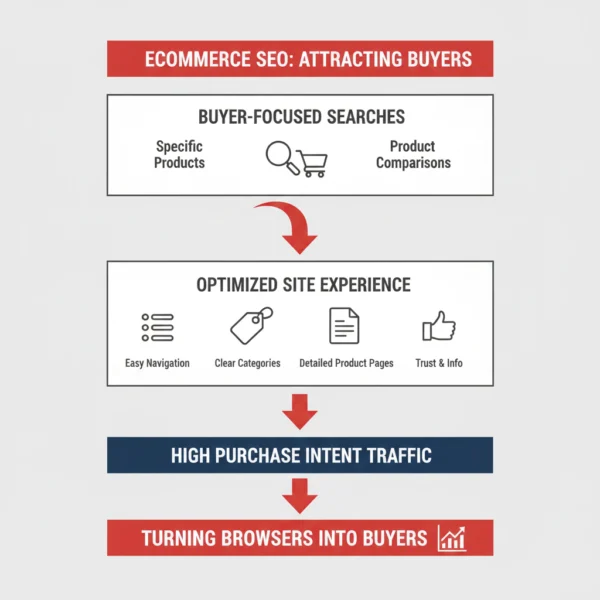
The value of not every searcher is equivalent. Some people are only doing research, while others are decidedly ready to buy. The goal of ecommerce SEO is to gather in the second group by setting up your site in alignment with real purchase intent.
Buyer searches are different. They look for specific products, product types, comparisons between them and prices. They check where it’s available. Therefore, when you optimize site pages to service these purchase-driven searches, you get users who are about to make up their minds. This is far from the broad keywords that always bring traffic, but with no certain intent behind it.
Ecommerce SEO also makes it easier for buyers to find what they want. An easy-to-understand category structure, well optimized product pages and sensible navigation make things go smoothly. When the user arrives quickly at exactly the page they need, he will tend not to leave as often.
Another important point is trust. Search engines favor ecommerce stores that give unambiguous information, useful material, and a pleasant experience. But these signs at the same time help make users confident enough to buy.
By setting up your site to match buyer-focused searches and minimizing obstacles in the purchase path, ecommerce SEO turns organic traffic into real opportunities. Instead of acquiring visitors just browsing around a site, it brings in users who are already ready to buy.
3. Keyword Intent and Product Discovery That Leads to Purchases
The keywords used in this stage can make or break e-commerce SEO. While ranking improperly worded searches may bring people to your site, it won’t deliver any sales. By giving search intent more attention, an SEO strategy aimed at ecommerce becomes less concerned with what someone is typing and more interested in why they are scouring the internet.
Buyers move through clear phases; some are in the market for a product, others compare offers of comparable products, others check prices and yet others are ready to buy. Focused on those stages Ecommerce SEO matches up key words to the right sort of advertising material. Product pages should capture searches with high intent, whereas category pages aid in discovery across a broader range of products.
What matters at this juncture is one’s discovery as much as what your intention is. When users arrive at your site but cannot find the products they were looking for, they leave. This is another area where SEO plays a part because it connects into shaping categories as well as organizing filter output, incorporating internal links to lead users on through to just the right product moment.
Instead of chasing high volume keywords, good ecommerce SEO pursues clarity and relevance. When search intent, the purpose of the page, and the availability of products all align perfectly, users move naturally from being curious about an item to checking it out then, once satisfied with what they have seen online they are prepared to purchase off line in stores or elsewhere. That is how SEO supports actual purchases and helps an ecommerce site to convert visibility into sales.
4. Category and Product Page Optimization for Higher Conversions
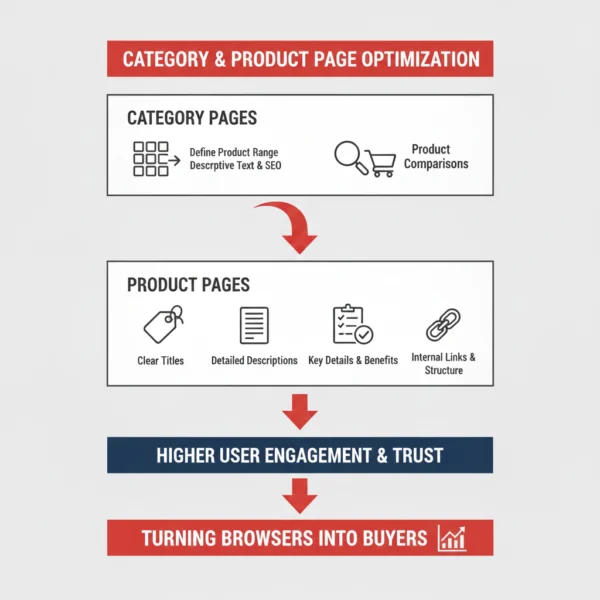
Category and product pages are where ecommerce sales actually happen, which is why SEO work here needs to go beyond rankings. These pages must help both search engines and users understand what is being sold and why it is worth buying.
From an SEO point of view, category pages should clearly define the product range. They need simple, descriptive text that explains what the category includes and who it is for. This helps search engines match the page with relevant searches and helps users confirm they are in the right place.
Product pages need even more care. Titles should make clear exactly what is being sold, descriptions should be accurate and to the point, and useful details should be included to cut down on Hemming and hawing. When users can quickly understand what a product offers, how it fits their needs, and what to expect, they move toward purchase more often than not.
SEO also supports conversion through structure. Clean URLs, logical headings, and internal links between related products help guide users without overwhelming them. Little improvements like these raise the bar for usability, reduce hurdles somewhat, and keep people engaged when they visit your site.
When category and product pages are optimized with both intent and usability in mind, SEO ceases to be just a tool for visibility. It becomes a direct carryover that aids online merchantability.
5. Technical SEO Issues That Quietly Kill Ecommerce Sales
Problems in technical SEO are often overlooked, for the site may still look smooth on the surface. Merchandise loads quite normally, pages show up in the search results, and still orders pour in. However, behind-the-scenes such problems slowly erode visibility, trust, and conversions.
Site speed is one of the biggest killers. Slow loading product pages particularly jolt and regress on mobile for users, dealers might be swept into oblivion. In ecommerce, even a fraction of one moment can mean fortune. Search power also factors speed into rankings, so the hurt is twofold.
Crawl and indexing problems are another hidden barrier. If key categories or product pages are not being crawled properly, they won’t rank. In some instances, filters, parametric, or URL mishandling make duplicate pages that diminish overall performance.
Mobile usability is also crucial. Ecommerce sites that are difficult to navigate via mobile lose rankings and customers alike. A technical SEO review pays attention to whether buttons, images, and checkout flows all work smoothly across devices.
Technical SEO is not so much about perfection as it is reductive. When an ecommerce site loads quickly, operates well on mobile and signals uncluttered to search engines, it is much easier to convert visitors into buyers.
6. Content That Supports Buying Decisions in Ecommerce SEO
Such advice explains the essence not grasped by many in the search industry. It is the key to help people who do worship search engines instead of using them and understand what the world looks like.
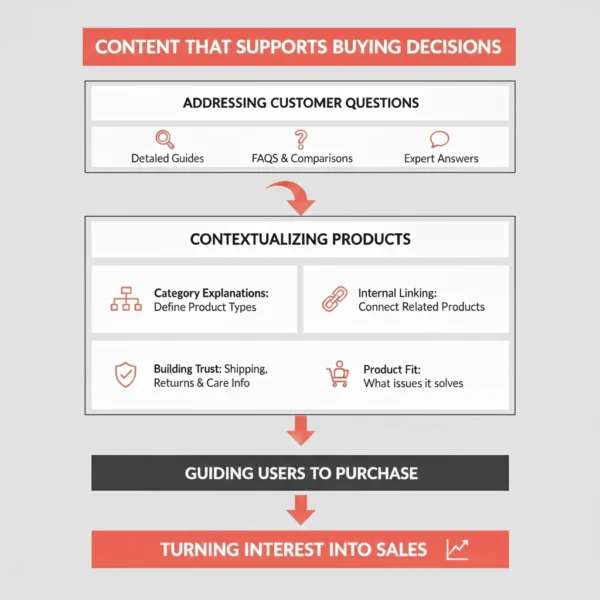
In E-commerce, content does not serve as it does in other sectors (e.g., IT services ). Whether users make successful purchases or not depends on the existence of this information. SEO driven content works best when it conforms to real questions that customers have before they buy.
It is especially important for users to make decisions when they see something else being ordered. It is possible that the guide you presented helped them, but hasn’t directed anything in itself. On the other hand, if usage is compared and benefits are explained in detail users can understand these differences. As a result they will have more confidence toward you than before.
To help give context to category and product pages, content is also linked directly there. It explains which sorts of products the categories include, for whom any given product might work out well, or on what issues it might prove helpful in close coordination with other products from the same Brand. This way, search engines can grasp the relations between different sections while users are served better.
Another task for content handling doubt. Whether a user will buy now, think it over for later or walk away tonight and come back again next week hinges on the details of how you handle those negative messages from shipping info return policies and product care information. If you make this information easy to find users become convinced more quickly. Any vomiting backwards at this particular stage will kill your sale.
When the content is aligned to the user’s needs or desires, it becomes a partner in tying up deals. E-commerce SEO uses content strategically to lead users from interest all the way into product without overwhelming them.
7. Internal Linking and Site Structure That Push Users Toward Checkout
The concept of internal linking is in many cases driven by technical stuff such as file-level domains. In ecommerce, however, it can have a direct impact on sales. How pages are linked together determines how easily users can progress from discovery to purchase.
A well-organized site structure makes it easy for users to find products. When categories, sub-categories, and product pages can be linked through logical associations shoppers don’t have to spend their time looking just buying. SEO audits for ecommerce often find that important products are buried in subordinate categories or otherwise not within easy reach.
Internal links also provide the means to guide the desired intent. By linking from category pages out to best sellers, related products or products that complement each other people can move in more natural space. This gets them engaged and increases the likelihood of mouths sparkling with more items in them.
From a search engine point of view, internal links also convey authority. When important pages are from the relevant sections of your site, websites linking to those pages provide a stronger signal for rankings. This increases visibility and makes rankings better where it really matters most.
With internal linking and structure in place to accommodate both search engines and users, this e-commerce SEO will be more successful in building smoother customer journeys and higher conversion rates. Minor tweaks to the structure can often have a big impact on sales value changes.
8. Trust Signals, Reviews, and SEO Factors That Influence Ecommerce Sales

Whether a visitor can become a customer largely depends on trust. Trust signals in ecommerce and quality signals on the other systems are not just about branding; they also directly affect rankings, click-through rates, and conversions more influential than any ad-words ad blocking software could ever be.
Search engines are constantly looking for signals that show a site is trustworthy. This can be anything from how well-known an SEO company is or has been in the past, to combination of reviews, ratings and unchanging business information which makes sure that there’s always real customers engaging with the brand. Pages that have strong trust pointers are just better because when users do their research, they stay longer, look slightly further down the page and tend to continue through purchase.
Customer reviews are of supreme importance. They provide new content, reinforce product relevancy, and answer the questions potential buyers may not realize they have. From a search engine optimization point of view reviews also help a page to remain active and updated in the face of an ever-changing world.
Other signs of trust are clear policies, secure checkout procedures and transparent product information. When users are confident of these aspects, they will proceed to the next stage. This reduces doubt and decline rates for people who are in the process of buying.
Ecommerce SEO is about the built in trust that you create naturally. By increasing these signals websites not only achieve better visibility on search engines but also provide an environment where visitors feel able to spend money.
9. Schema Markup for E-commerce Products and Rich Results
When you add schema markup to your now somewhat confusing ecommerce page, products will appear more clearly for Google to read than they did under the old code.
Details like price, stock status, and ratings are all part of the product schema. When these elements show directly in search listings, they make results more attractive and help users decide to click before they even reach your site.
Schema also supports the principle of ownership when product data in schema matches what appears on the page, search engines gain more confidence in accuracy and relevance. This reduces misunderstandings that can limit visibility or trust.
In addition, structured data can help answer engines. When more precise product details are visible to search systems, this improves your chances of being discovered in various search formats (eg. as a featured snippet).
While schema markup does not replace SEO fundamentals, it can strengthen them. For ecommerce businesses it is a practical way to increase visibility, click through rates, and overall sales potential without changing the core content.
10. Final Thoughts:
Seeing that every action-from technical setup as well as content and form-plays a part in assisting potential buyers to find products and purchase them with confidence, it is obvious that Ecommerce SEO dividends tend to accumulate over a long period of time. Aligning the buying intent With SEO smooths out product exploration paths and reduces friction in the checkout process. Eventually, this results in higher-quality traffic, better conversion rates and more evenly paced revenue figures than taken via paid channels alone.
SEO offers something for ecommerce brands competing in busy sectors that ads just can’t provide long-term exposure with compound effect. By investing in ecommerce SEO services that focus on actual business outcomes, businesses can turn their presence in searches into a constant source of growth in sales.
Are you struggling to get more traffic?
Run a free SEO analysis to uncover site issues, competitor gaps, and ranking opportunities.