Why Healthcare SEO Matters in 2025
If you run a clinic, a private practice, or a health brand in 2025, you already see how people search for care. Referrals still help, but most journeys now begin with a quick query like “dentist near me,” “dermatologist for acne,” or “best physiotherapy in London.” That first search is where trust starts to form.
Healthcare SEO is not only about high rankings. It is about showing up when people feel worried and want clear answers from a qualified source. With a well-optimized site, patients find accurate information from you, not a mix of random advice on forums or social feeds.
Credibility plays a bigger role this year. Search engines treat medical topics differently because quality can affect someone’s well-being. If a site does not show real expertise, identity, and accuracy, Google will usually filter it out in competitive results.
Here is the upside. A clinic that invests in local listings, clear content, and a tidy technical setup can double qualified inquiries within a few months. The change is not only volume. Visitors arrive better informed, more confident, and ready to book.
A thoughtful SEO program builds that trust every week. The rest of this guide breaks the work into simple parts so you can apply it in a real clinic or practice.
Understanding Healthcare SEO
Healthcare SEO helps patients, caregivers, and referring doctors find reliable information quickly. Keywords and rankings matter, but the deeper job is alignment. You shape your online presence around how people actually search for symptoms, services, and nearby specialists.
Unlike a standard business site, a healthcare site carries emotional weight and real risk. Choosing a provider is a big decision. That is why healthcare SEO blends visibility with credibility.
Think about three outcomes:
-
Help people find you:
When someone searches for symptoms, conditions, or local specialists, your content should appear as a trustworthy answer.
-
Build authority
Articles reviewed by professionals, clear credentials, and current references help patients feel safe choosing you.
-
Support long-term growth
Paid ads stop when the budget stops. SEO keeps bringing qualified visitors month after month.
Healthcare SEO also has higher standards than general SEO. Follow E-E-A-T, which stands for Experience, Expertise, Authoritativeness, and Trustworthiness. Show credentials, cite reputable sources, keep information updated, and avoid vague claims.
Example: A physiotherapy clinic writing about lower back pain should name real clinicians, reference clinical sources, and add local context for nearby patients. That level of detail helps both readers and search engines trust the page.
With that foundation set, let’s break SEO into practical pillars.
Core Pillars of Healthcare SEO
In day-to-day work with clinics and health brands, four pillars consistently drive results. They mirror what top agencies recommend, but here they are tuned for healthcare teams.
1) On-Page SEO
On-page work covers everything you can control on the page. In healthcare, focus on clarity, trust, and patient language.
-
Use patient terms:
Write the way people search. For example, “knee pain treatment clinic London” is more natural than “orthopaedic arthroscopy practice.”
-
Tight metadata:
Title tags and meta descriptions should match the query and promise a clear answer. Glacial Multimedia highlights keyword research, metadata, content quality, and technical hygiene as the core on-page set.
-
Trust-building content:
Service pages, doctor profiles, condition explainers, and FAQs should list credentials, cite sources, and show last review dates.
-
Readable structure:
Short paragraphs, subheadings, bullets, and helpful tables make content scannable for an anxious reader.
-
Internal links:
Connect service pages with relevant blogs and guides to build strong topic clusters.
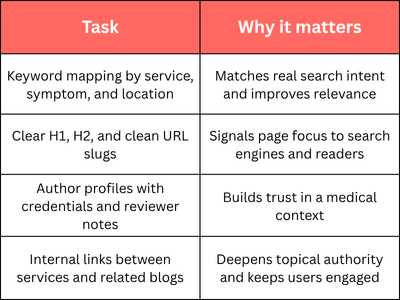
Example table: common on-page tasks for a clinic site
2) Technical SEO
Even the best content will underperform if your site is slow, messy, or hard to crawl. Health sites must pass a higher trust test.
-
Mobile first and fast:
A slow mobile site loses rank and credibility. A practical guide notes you need a responsive, user-friendly site on any device.
-
Clean architecture and indexing:
Make sure Google can reach core pages such as services, locations, and clinician bios.
-
Security:
HTTPS is essential. Patients expect private forms and a safe experience.
-
Schema markup:
Use LocalBusiness, MedicalBusiness, MedicalCondition, MedicalProcedure, and FAQ schema where relevant. Location pages should include LocalBusiness schema and consistent NAP.
-
Core Web Vitals:
Keep pages quick and stable to protect rankings.
Practical tip: Run a technical audit at the start of any healthcare SEO project and repeat every six to twelve months. Fixing technical blockers often unlocks the biggest, fastest gains.
3) Local SEO
For any clinic with a physical location, local search is the workhorse for new patient acquisition.
-
Google Business Profile:
Claim and complete your listing. Add categories, hours, photos, services, and updates. Reviews are a major visibility and conversion factor.
-
Location pages:
If you serve multiple areas, create a page for each location with unique, helpful content.
-
Citations and directories:
List your practice on trusted healthcare and local directories. Keep NAP consistent everywhere to avoid confusion.
-
Review cultivation:
Fresh reviews matter more than sheer volume. Reply promptly and encourage satisfied patients to share experiences. Text data cited by Digitalis Medical supports the impact of recent activity.
-
Local schema and “near me” phrasing:
Write naturally but include city or neighborhood names in titles, headings, and copy.
-
Quick case insight:
A small physiotherapy clinic in London added a complete Google Business Profile, asked for four to five new reviews each month, and built a “Physiotherapy in Bermondsey” page. Within six months they moved from page two to page one for “physiotherapy Bermondsey,” and contact form submissions rose by about thirty five percent.
4) Off-Page SEO and Authority
This is how the wider web signals your credibility.
-
High-quality links:
Prioritize links from medical associations, NHS-adjacent resources, reputable health sites, and local institutions.
-
Brand reputation:
Healthcare falls under YMYL. Doing medical SEO well means earning strong signals of expertise, authority, and trust.
-
Partnerships and citations:
Publish data-backed resources, collaborate with universities, or share case studies that others will reference.
-
PR and social proof:
Social might not be a direct ranking factor, yet it increases brand activity and referral traffic, which supports authority.
Simple action plan
Publish a research-informed article, for example “Early physiotherapy and back pain recovery,” then seek a quote or link from a local medical school.
Sponsor a community health event and request a site link from the organizer.
Set alerts for brand mentions and convert unlinked mentions into links.
Bringing the pillars together
On-page helps you say the right things. Technology helps search engines and people reach those pages quickly and safely. Local puts you in front of nearby patients at the exact moment of need. Off-page raises your reputation so everything else performs better. Skip one pillar and the results flatten. Cover all four and you build steady, compounding visibility.
Keyword Research for Healthcare Websites
Keyword research turns guesswork into a plan. It shows how people describe their problems and which phrases lead to bookings. A search for “skin specialist near me” signals location and intent. A search for “how to stop tooth sensitivity” signals education and reassurance.
Why keyword research matters
Healthcare searches are personal. People type what they feel, not what appears in a textbook. A dentist may write “orthodontic correction,” while a patient types “fix crooked teeth.” Good research bridges that gap.
It helps you:
See how patients think and search.
Uncover content you might miss, like FAQs or symptom checklists.
Align pages to real intent so you show up when decisions happen.
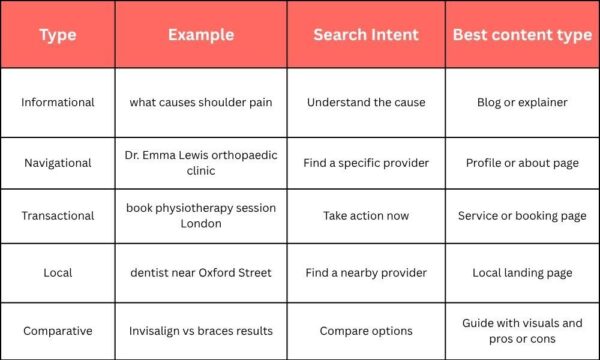
Types, intent, and best content match
How to build your list
Start with your services, then add the phrases patients would use.
Use autocomplete and People Also Ask to gather real queries.
Review competitor rankings in Ahrefs or SEMrush if available.
Check Google Search Console for terms you already appear for.
Add location intent, for example “pediatrician in Birmingham.”
Example: A Manchester physio that offers sports injury recovery often finds that people search more for “knee injury exercises” or “football injury treatment near me.” Adding those phrases to services and blogs increases both reach and relevance.
Cluster your keywords
Group related terms into clusters that mirror your site structure. One cluster supports a main page and several subtopics. Internal links then help Google understand your depth.
Example cluster: Back pain treatment
Main page: Back Pain Treatment in Manchester
Supporting topics: causes of chronic back pain, lower back pain relief at home, when to see a physio for back pain, back pain clinic near me.
How to prioritize
Look at search volume, difficulty, relevance, intent to book, and local fit. Mix a few broad terms for visibility with specific long-tail terms that convert. Track which ones drive inquiries and shift focus over time.
Pitfalls to avoid
Chasing broad, generic terms that never convert.
Copying competitor lists without checking fit.
Skipping location modifiers on local services.
Letting research go stale. Refresh every few months.
Done well, keyword research becomes the backbone of your site plan and content calendar. Now let’s turn that research into pages that match search intent and read like they were written by a clinician who cares.
Optimizing Healthcare Content for Search Intent
Once your keywords are mapped, convert them into pages that meet what people want. Many medical sites are accurate but hard to find or hard to read. The goal is to bridge expertise with accessibility.
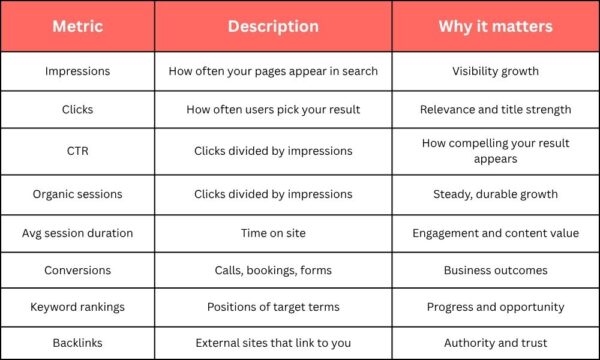
Match content to intent
Every query signals a purpose. Some readers want education, some want reassurance, and others want to book.
Write with empathy and clarity
Medical content often reads like a textbook. People search when they are anxious or in discomfort. Use plain language and short paragraphs.
Instead of “We provide periodontal treatments for gingival inflammation,” try “If your gums bleed when you brush, our team can help treat and prevent further discomfort.”
Instead of “Patients are advised to consult specialists prior to intervention,” try “Our specialists will guide you through your options before any treatment.”
Simple does not mean less professional. It means more human.
Structure for people and search
Search engines and readers reward clarity.
Use clear headings that include keywords naturally.
Open each section with a short, helpful intro.
Link related pages and posts internally.
Add FAQ blocks for common questions.
Consider FAQ or HowTo schema where it fits.
Example subheads for a “lower back pain treatment” page
Common causes of lower back pain
How physiotherapy helps
Home exercises that can help
When to seek professional support
Balance expertise with discoverability
Use verified data, cite credible sources, and show author credentials and review dates. This supports E-E-A-T.
Use lists for steps or care instructions.
Include diagrams or simple visuals when helpful.
Add case vignettes or patient stories where appropriate.
Laser treatment example: If you cover “skin laser treatments,” include a section on realistic before and after expectations, reference a certified dermatologist, and cite sources such as the NHS or PubMed.
Prepare for voice search and answer boxes
Include short, direct answers under question subheads. This helps with featured snippets and voice assistants.
Example short answer.
“What causes jaw pain?”
“Jaw pain can result from teeth grinding, joint disorders, or dental infections. A dentist can confirm the cause with an exam and imaging if needed.”
Keep content updated
Treat key pages as living resources. Update stats, treatment names, and internal links every few months.
Effective healthcare content speaks to two audiences at once. Patients feel informed and safe. Search engines see relevance and clarity.
Building Local SEO Dominance for Clinics and Practitioners
Local SEO is the main route to reach people who are ready to act. If your presence is not tuned for locality, you lose to clinics that are.
Why local SEO matters
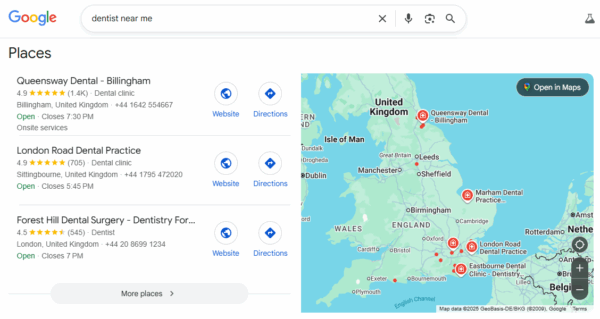
Searches like “dentist near me” or “physiotherapist Manchester centre” often lead to a choice the same day. Clinics with accurate listings and active reviews show up higher and convert better.
If your details are inconsistent across directories or your map profile is thin, people click someone else.
The key building blocks:
-
Optimize your Google Business Profile
Claim the listing and complete every field. Add your address, phone number, hours, categories, services, and high-quality photos of your clinic and team. Choose a precise primary category such as “Dental Clinic” or “Physiotherapy Clinic.”
-
Maintain NAP consistency
Your Name, Address, and Phone number should match across your site, your map listing, and trusted directories. Inconsistencies confuse people and search engines.
-
Create location-specific pages
If you serve multiple areas, create a unique page for each location with distinct content and local cues.
-
Collect and manage reviews
Encourage happy patients to leave reviews, reply to feedback quickly, and handle negatives with care. This supports both rankings and trust.
-
Build local citations and healthcare directory listings
Choose relevant, reputable directories. Avoid spammy lists.
-
Optimize for “near me” and city terms
Use natural phrasing and add the city or neighborhood in titles, headings, and copy where appropriate.
Example rollout
Claim Google Business Profile with “Physiotherapist” as category.
Ensure the same phone number and address appear on the site, listing, and key directories.
Build a page for “Physiotherapy for Back Pain in Manchester.”
Ask satisfied patients to mention “Manchester” in reviews when relevant.
List the clinic in reputable local and medical directories.
Monitor map pack visibility and calls from the listing.
Within three to six months, expect more local impressions, better map placement, and higher quality inquiries.
Pitfalls to avoid
Incomplete Google Business profiles.
Different phone numbers or addresses across platforms.
Targeting regions that are too broad.
Ignoring reviews or using duplicate location pages with thin content.
E-E-A-T and Trust Signals in Healthcare SEO
Trust rules healthcare. People act carefully when health is on the line. Google knows this and evaluates medical content with higher standards.
E-E-A-T stands for Experience, Expertise, Authoritativeness, and Trustworthiness:
Experience relates to first-hand or clinical understanding.
Expertise refers to credentials and professional training.
Authoritativeness grows through recognition by others such as citations and reviews.
Trustworthiness shows through transparency, accuracy, and honest presentation.
Show experience and expertise
Make your authors and clinicians visible. Include names, roles, qualifications, and specialties. If a doctor writes or reviews a piece, say so on the page.
Example
“Reviewed by Dr. Sarah Ahmed, Consultant Dermatologist, GMC No. XXXXX”
Add professional insight inside the copy.
“Our dermatologists use fractional laser therapy to reduce visible scarring. In mild cases, patients often notice improvement within three sessions.”
Build authoritativeness
Authority comes from outside signals.
Seek mentions on credible platforms such as medical directories, journals, or partner hospitals.
Collaborate with peers or universities and publish findings or case summaries.
Maintain accuracy and consistency across all content.
Strengthen trust
Trust shows in small details.
Use HTTPS and visible privacy practices.
Display accurate contact details.
Avoid exaggerated claims.
Update articles with new studies and guidelines.
Encourage authentic reviews.
Link to trustworthy sources such as the NHS, WHO, or PubMed when you reference facts.
Clinic example:
A private cardiology clinic in London can publish articles reviewed by cardiologists, show bios with GMC numbers, add patient testimonials with verified first names and city, and cite British Heart Foundation studies. These signals guide both people and algorithms to a conclusion that the clinic is credible.
Technical SEO Essentials for Healthcare Websites
A fast, secure, and well-structured site is the silent engine behind all content. People will not wait for a slow medical page to load, especially when they are worried.
Why technical SEO matters more in healthcare
Medical sites fall under YMYL standards. Reliability must show at every level, from hosting to on-page signals. If a site looks modern but loads slowly, breaks on mobile, or shows mixed security warnings, trust erodes and rankings follow.
1) Mobile-first experience
Most visitors arrive on a phone. Design for speed, clarity, and easy actions.
Test with Google’s Mobile-Friendly Test.
Keep buttons easy to tap.
Compress images and avoid heavy animations.
Avoid full-screen popups that block key actions.
2) Site speed and Core Web Vitals
People in need are impatient. A one-second delay can reduce conversions in a measurable way.
Focus on:
Compressed images through tools like Squoosh or TinyPNG.
Browser caching and a lightweight theme.
Minimal scripts and tags.
Strong Web Vitals such as LCP under 2.5 seconds, FID under 100 ms, and stable layout.
3) Secure and compliant infrastructure
Install and renew SSL.
Use secure form processors for appointment or inquiry data.
Show privacy policies and security signals clearly.
Follow HIPAA or GDPR where applicable.
4) Structured data and schema
Help search engines understand your content.
MedicalBusiness for clinics and hospitals
Physician for individual doctors
MedicalCondition and MedicalProcedure for information pages
FAQ for common questions
LocalBusiness for each location
This can unlock rich results and improve context in search.
5) Site architecture and crawlability
Use a simple hierarchy.
Homepage → Services → Conditions → Blog → Contact
Keep URLs descriptive, for example /dermatology/acne-treatment.
Submit an XML sitemap in Google Search Console. Review crawl stats monthly.
6) Accessibility and ADA alignment
Accessibility is ethical and practical.
Write descriptive alt text for images.
Maintain adequate color contrast.
Use proper heading order.
Provide captions or transcripts for videos.
7) Ongoing technical hygiene
Technical work is never one-and-done.
Audit monthly for errors or slow assets:
Fix broken links.
Watch Search Console for index issues.
Keep CMS, themes, and plugins updated.
Check robots.txt to avoid blocking important pages.
When a medical site feels fast, clean, and safe, people relax and engage. Search engines read those same signals and reward them.
Measuring and Improving SEO Performance
You cannot improve what you do not measure. A site can look great, but if visits never turn into bookings, it is not serving the clinic.
Why tracking matters
People come to healthcare sites because they need help. Tracking shows how they find you and where they drop off. It reveals which pages lead to appointments and which ones lose attention.
Core metrics
Tools that help:
Google Search Console for queries, indexing, and visibility.
Google Analytics 4 for behavior and conversion tracking.
Ahrefs or SEMrush for keywords, competitors, and links.
Call tracking to connect phone leads to source.
Google Business Profile insights for local searches, calls, and direction requests.
Turn numbers into actions
Do not report numbers without context.
Identify pages that create bookings and pages that leak traffic.
Compare search terms with the services you want to grow.
Trace common user paths from entry to conversion.
Review mobile performance and fix friction that hurts calls or forms.
A simple improvement cycle
Review data monthly.
Compare quarter over quarter.
Refresh aging pages that are slipping.
Fix technical issues as they appear.
Test new layouts, CTAs, or internal links and keep what works.
Example: A Leeds physio saw most traffic land on home exercise blogs. They added a short line that linked to booking pages, “Ready for a guided plan? Book a session.” Eight weeks later, form submissions rose by more than twenty five percent.
Clear reporting builds trust
When you present results, write like a guide, not a spreadsheet. Explain what changed, why it matters, and what you will do next.
Common Healthcare SEO Mistakes to Avoid
Small issues can block growth. These are the pitfalls to watch.
Treating healthcare like any other industry
YMYL standards apply.
Avoid hype and unverified claims.
Focus on accuracy, clarity, and empathy.
Ignoring local optimization
Unclaimed profiles, messy NAP details, and thin location pages cause losses to nearby competitors.
Neglecting mobile and technical performance
Slow, glitchy sites signal low credibility.
Compress assets, simplify templates, and keep key actions visible on small screens.
Forgetting search intent
Educational queries need blogs.
Booking intent needs strong service pages with immediate paths to act.
Skipping E-E-A-T and author details
Anonymous content struggles.
Add author names, credentials, citations, and review dates.
Writing for algorithms instead of people
Keyword stuffing and robotic tone drive readers away.
Use natural language and helpful structure.
Ignoring analytics
Publish with tracking in place.
Learn what converts and refine often.
Letting content go stale
Update key pages with new studies, guidelines, and internal links.
Overlooking accessibility
Missing alt text and low contrast limit who can use your site.
Separating SEO from the patient journey
Align search listings, on-page messaging, forms, and follow-up emails so the experience feels consistent.
Conclusion: The Long-Term Impact of Healthcare SEO
Good SEO grows like trust. Each review, article, and technical improvement adds a small gain. Over time, those gains become steady visibility, lower acquisition costs, and a brand that people recognize and rely on.
SEO as a sustainable growth engine
Paid exposure ends when the budget ends. A strong page can rank for months or years and bring visitors at no extra cost. As your domain earns links and engagement, new pages rank faster. Compounding starts to work in your favor.
Building trust beyond rankings
Visibility is not enough in healthcare. Repeated, helpful appearances across search results build recognition. A dental clinic that publishes clear, factual pieces on oral care becomes a helpful guide. That credibility carries into offline referrals as well.
The compounding effect of expertise
Search engines reward depth. A clinic that covers physiotherapy, posture, and recovery with practical, well-structured guides becomes the obvious result for those topics. Each strong page helps the next one.
Learn from the data
Analytics show seasonal patterns and local habits. You might learn that “pediatric dentist near me” spikes before school starts, or that bookings rise after work hours. Use these signals to plan content and capacity.
A human approach to lasting visibility
Behind every search is a person who wants clarity or relief. Accurate, compassionate, and accessible content helps them move forward. SEO makes that content easy to find at the right moment.

Are you struggling to get more traffic?
Run a free SEO analysis to uncover site issues, competitor gaps, and ranking opportunities.