SEO vs GEO vs AEO has become one of the biggest debates in search right now, especially after the rise of AI Overviews, ChatGPT, and answer-driven search experiences. A few years ago, ranking on Google was the main goal. If your page reached the top results, you usually captured the traffic. That model still matters, but search behavior is changing much faster than many companies expected. Read SEO vs GEO vs AEO in this blog.
We’re already seeing informational pages gain impressions while clicks flatten because users increasingly get answers directly inside Google, ChatGPT, Gemini, and other AI tools before visiting a website. That shift is also forcing companies to rethink how they approach modern SEO content writing strategies built for AI-driven discovery environments.
Some marketers treat SEO, AEO, and GEO like completely separate strategies. Others assume GEO replaces traditional SEO altogether. Neither approach is accurate. The reality is that modern search visibility now happens across multiple layers at the same time. Traditional rankings still matter. Direct-answer extraction matters. AI-generated visibility also matters.
This guide breaks down the real difference between SEO, AEO, and GEO where each one actually matters, and how content teams can adapt without chasing every new AI trend blindly.
SEO vs GEO vs AEO: Quick Answer
SEO focuses on improving rankings in traditional search results. AEO focuses on helping content appear as direct answers in featured snippets and voice search. GEO focuses on making content visible inside AI-generated responses like ChatGPT, Gemini, and Google AI Overviews. Modern search visibility now depends on combining all three instead of relying only on rankings.
What Is SEO, AEO, and GEO?
SEO, AEO, and GEO are closely connected, but they solve different visibility problems in modern search.
What Is SEO?
SEO focuses on helping pages rank in traditional search engines like Google and Bing.
The goal is usually organic traffic. That includes improving content relevance, technical performance, internal linking, backlinks, and search intent alignment so users click through to the website.
If someone searches:
“best email marketing software”
SEO is competing for visibility in the standard organic results.
What Is AEO?
AEO stands for Answer Engine Optimization.
Instead of focusing only on rankings, AEO focuses on helping content appear as direct answers inside featured snippets, People Also Ask sections, voice search, and AI summaries.
This changes how content should be written.
Pages performing well in answer-based search usually explain concepts quickly, structure information clearly, and avoid hiding the answer beneath long introductions.
We’ve seen pages win snippets after simplifying the opening explanation even without major ranking improvements.
What Is GEO?
GEO stands for Generative Engine Optimization.
It focuses on helping AI systems understand, trust, and reference content inside AI-generated responses from platforms like ChatGPT, Gemini, Perplexity, and Google AI Overviews.
Unlike traditional SEO, GEO is less about blue-link rankings alone.
The goal is making content useful enough that AI systems can summarize, cite, or reference it while generating answers. That usually requires stronger topical depth, clearer context, practical examples, better entity relationships, and more original insight.
This is one reason generic AI-generated content often struggles in AI search environments. Rewritten summaries rarely add enough value to stand out.
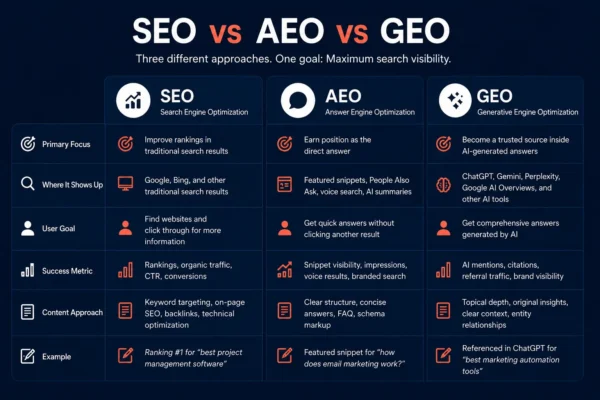
Key Differences Between SEO, AEO, and GEO
SEO, AEO, and GEO are closely connected, but they focus on different types of visibility inside modern search.
Traditional SEO is still heavily tied to rankings and traffic. AEO focuses more on direct-answer extraction through featured snippets and AI summaries. GEO focuses on helping AI systems understand and reference content across conversational search experiences.
The biggest change is that visibility no longer happens in one place alone.
A page can now rank in traditional search results, appear inside featured snippets, influence AI-generated answers, and generate branded discovery across multiple platforms at the same time.
That’s why SEO, AEO, and GEO work better as connected visibility strategies instead of completely separate systems.
SEO Focuses on Rankings and Traffic
Traditional SEO is still heavily tied to organic rankings.
The goal is usually simple: rank higher, earn more clicks, and increase traffic.
That still matters for commercial searches, product pages, service pages, comparison keywords, and navigational queries.
If someone searches for “best project management software,” Google still shows traditional organic results heavily influenced by SEO signals like authority, backlinks, technical SEO, relevance, and search intent.
SEO remains the foundation of discoverability.
AEO Focuses on Direct Answers
AEO changes the goal from “get the click” to “become the answer.”
This usually happens through featured snippets, voice assistants, People Also Ask results, and AI-generated summaries.
One thing many teams underestimate is how much formatting affects answer visibility. We’ve seen pages lose snippet opportunities simply because the explanation was buried too deep inside long introductions or oversized paragraphs.
The pages that usually win answer extraction are direct, clearly structured, easy to scan, and concise without feeling thin. Clarity matters more than length in answer-driven search.
GEO Focuses on AI Visibility
GEO works differently from both SEO and AEO.
Instead of optimizing only for rankings or extracted snippets, GEO focuses on helping AI systems understand and reference content while generating responses.
That’s becoming more important as users increasingly search through ChatGPT, Gemini, Perplexity, and Google AI Overviews.
In these environments, content competes less on keyword placement alone and more on usefulness, context, and topical understanding.
AI systems also appear to rely more heavily on trusted sources, strong topical authority, and consistently useful content when generating responses.
We’re already seeing generic “definition-only” articles struggle because AI systems can generate those summaries without needing a specific source.
Pages that perform better usually add original observations, deeper comparisons, practical explanations, and stronger context around the topic.
The Biggest Shift Is Visibility Itself
A few years ago, success in search mostly meant rankings and traffic.
Now visibility happens across multiple layers at once.
A page might:
- rank organically
- appear in a featured snippet
- influence an AI-generated answer
- generate branded searches later
That’s why SEO, AEO, and GEO should not be treated like competing systems.
They are different visibility layers inside the same evolving search ecosystem.
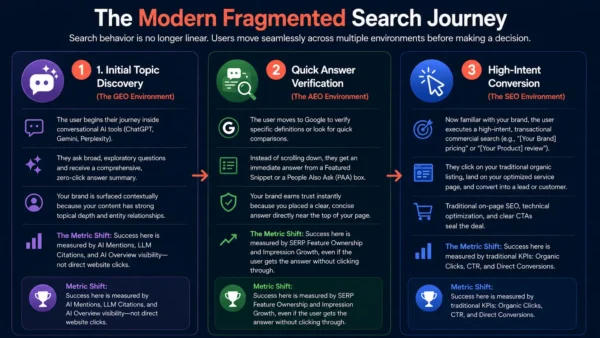
How to Optimize for SEO, AEO, and GEO
SEO, AEO, and GEO overlap in some areas, but the execution is different for each one.
That’s where many companies get stuck.
They publish one type of content and expect it to perform across every search environment. In practice, different search systems reward different content behaviors.
SEO Still Starts With Search Intent
Traditional SEO still depends heavily on matching the intent behind the query.
If the search is transactional, users usually expect the following :
- product comparisons
- pricing information
- service pages
- category pages
If the search is informational, users expect explanations and guidance.
One thing we keep seeing is that many pages fail because they target the wrong intent entirely. A page trying to rank for a commercial keyword with purely educational content usually struggles no matter how optimized it looks technically.
SEO still relies heavily on:
- search intent alignment
- technical structure
- internal linking
- topical relevance
- authority signals
Those fundamentals have not disappeared.
AEO Depends on Clarity
AEO performs best when content answers questions quickly and clearly.
Search engines extracting direct answers do not want long introductions or vague explanations. They want clean formatting and obvious answer sections.
We’ve seen pages improve snippet visibility after doing something as simple as moving the answer directly beneath the heading instead of hiding it lower on the page.
The pages that usually perform best for answer extraction:
- answer immediately
- use short paragraphs
- structure headings clearly
- avoid filler language
- simplify explanations
In many cases, clarity beats length.
GEO Rewards Depth and Context
GEO changes the optimization goal again.
AI systems are not only looking for keyword relevance. They are trying to understand:
- relationships between ideas
- topical authority
- contextual depth
- useful comparisons
- entity connections
That’s one reason shallow AI-generated content struggles in AI search environments. Generic summaries rarely provide enough unique value for AI systems to reference consistently.
We’re already seeing stronger performance from pages that:
- explain concepts practically
- add original observations
- compare ideas clearly
- connect related topics naturally
The content does not necessarily need to be longer.
But it usually needs to be more useful.
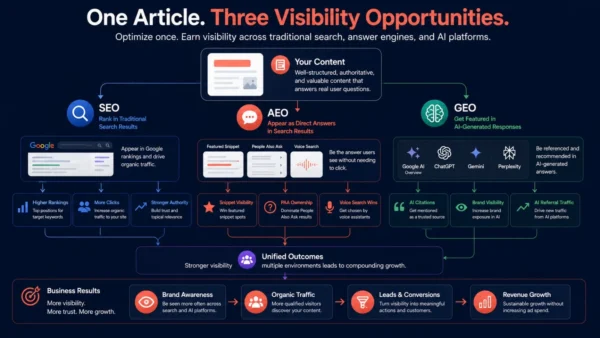
Search Intent Changes the Optimization Strategy
One of the biggest shifts in AI search is that different search intents now trigger completely different search experiences.
A few years ago, most SEO strategies focused mainly on rankings. Now the same keyword can produce organic search results, featured snippets, AI Overviews, and conversational AI responses.
That changes how content should be optimized.
Informational Searches Usually Favor AEO
Informational searches are where AEO becomes most important.
These are searches where users want a quick explanation instead of a deep buying decision.
Examples include:
- “What is GEO?”
- “How does AI search work?”
- “Difference between SEO and AEO”
Google often answers these queries directly through snippets, People Also Ask sections, or AI-generated summaries.
We’ve noticed that pages with long introductions often struggle here even when the information itself is good. Search engines usually prefer pages that answer the question immediately instead of slowly building toward the explanation.
That’s why many high-performing AEO pages keep answers near the top, use direct wording, simplify formatting, and avoid unnecessary filler.
Navigational Searches Still Depend on SEO
Navigational searches still behave much more like traditional SEO.
If someone searches for “Ahrefs pricing,” “HubSpot CRM,” or “Notion login,” they are trying to reach a destination.
In those searches, Google still relies heavily on authority, relevance, technical SEO, internal linking, and branded trust.
This is one reason SEO is still critical even as AI search grows. Users still need reliable destinations after discovery happens.
Exploratory Searches Are Becoming AI-Driven
Exploratory searches are where GEO becomes much more important.
These are broader searches where users are researching ideas instead of looking for one quick answer.
Searches like “How AI is changing SEO,” “Best AI search strategies,” and “SEO vs GEO vs AEO” increasingly trigger AI-generated summaries because users are exploring a topic rather than trying to complete one specific action.
We’re already seeing generic “definition-only” content struggle badly here. AI systems can generate those summaries themselves without needing a specific source.
The pages performing best usually add practical context, clearer comparisons, original observations, and stronger explanations around how ideas connect together. That shift is becoming especially important for companies competing in AI-driven discovery environments where broader topical authority increasingly influences visibility, similar to the challenges discussed in SaaS SEO.
That’s becoming one of the biggest differences between content written only for rankings and content that performs well in AI search environments.
What Actually Shows Up in Search Results Now?
One reason so many marketers are confused about SEO, AEO, and GEO is that search results no longer look consistent.
The same query can trigger traditional blue links, featured snippets, AI Overviews, and conversational AI responses. That changes where visibility actually happens.
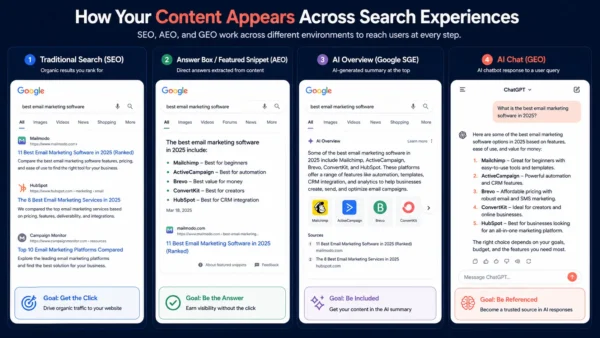
Traditional Search Results Still Drive Discovery
Traditional organic rankings still matter heavily, especially for commercial searches, product comparisons, service pages, and high-intent keywords.
If someone searches for “best accounting software for startups,” Google will usually still show standard organic results, review pages, and comparison articles.
This is where SEO continues doing most of the heavy lifting. Strong rankings still generate traffic, conversions, branded discovery, and authority signals. This is also where strong organic visibility continues supporting broader lead generation SEO strategies tied to high-intent search behavior.
But rankings are no longer the only visibility layer users interact with before making decisions.
Featured Snippets Changed Informational Search
Featured snippets changed how informational queries behave.
Instead of forcing users to click a page, Google often extracts a direct answer and places it above the organic results.
We’ve already seen cases where pages gained visibility after winning snippets even though overall rankings barely changed.
That usually happens on searches like:
- “What is AEO?”
- “How does GEO work?”
- “Difference between SEO and GEO”
Pages performing best here usually answer quickly, structure content clearly, avoid long introductions, and simplify explanations.
This is where AEO becomes much more important than traditional ranking tactics alone.
AI Overviews and AI Search Are Changing Visibility Again
AI-generated search changes the experience even further.
Tools like ChatGPT, Gemini, Perplexity, and Google AI Overviews often combine information from multiple sources into one generated response.
Users may never even open the original websites.
That changes how content competes.
We’re starting to see some informational searches where impressions continue growing while clicks flatten because users already received enough context directly from the AI-generated answer.
This is one reason many teams are rethinking how they measure visibility.
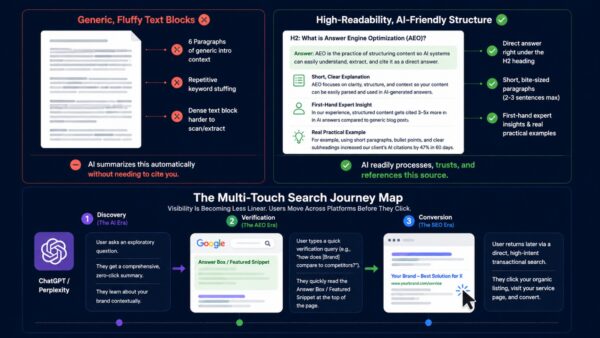
Visibility Is Becoming More Blended
Search behavior is becoming less linear.
A user might discover a topic through ChatGPT, verify information on Google, compare options through review sites, and return later through branded search.
That means content now needs to work across multiple search environments instead of depending only on rankings.
The strongest pages today usually do three things well: rank organically, answer questions clearly, and provide enough context for AI systems to understand and reference the content.
How to Structure Content for AI Search
One thing becoming obvious very quickly is that AI search rewards content structure much more aggressively than traditional SEO did.
A page can contain good information and still struggle because the structure makes it difficult for search engines or AI systems to extract useful context. Many of these improvements also overlap heavily with modern on-page SEO practices focused on readability, heading structure, and content accessibility.
We’ve already seen pages improve snippet visibility after simplifying headings, shortening introductions, and moving answers closer to the top of the page.
Put the Answer Near the Top
Many articles still delay the actual answer for too long.
That creates problems for both users and AI systems.
If someone searches “What is GEO?” they usually want the explanation immediately, not after six paragraphs of background context.
Pages performing well in answer-based search often define the topic quickly, keep introductions shorter, answer directly beneath headings, and expand afterward instead of before.
This is one reason concise answer blocks perform well in featured snippets and AI summaries.
Smaller Paragraphs Perform Better
Large text blocks are harder to scan, especially on mobile devices.
They are also harder for AI systems to extract cleanly.
That’s why modern search content increasingly uses shorter paragraphs, clearer heading structures, simpler formatting, and tighter explanations.
We’ve noticed that pages with cleaner formatting often outperform denser “ultimate guide” style articles even when both cover similar information.
Readability matters more now because users move faster across search experiences.
Context Matters More Than Keywords Alone
Traditional SEO often focused heavily on keyword placement.
AI search behaves differently.
AI systems are trying to understand relationships between concepts, topical depth, contextual relevance, and entity connections.
That’s why pages repeating the same keyword excessively usually add very little value in AI-driven search environments.
The stronger pages usually explain ideas naturally while connecting related concepts clearly.
Generic Content Is Becoming Easier to Ignore
AI-generated content has created a flood of articles repeating identical explanations.Most of them sound technically correct but add nothing new.
We’re already seeing that generic content struggles much more on exploratory searches where AI systems can generate basic summaries without needing a specific source.
Pages backed by clearer expertise, stronger credibility signals, and first-hand insights are becoming easier for both users and AI systems to trust.
The pages performing best usually include practical examples, clearer comparisons, stronger opinions, real observations, and more useful context.
That’s becoming one of the biggest differences between content written only to rank and content written to stay visible across modern search environments.
Real Example: One Topic, Three Different Optimizations
The easiest way to understand the difference between SEO, AEO, and GEO is seeing how the same topic changes depending on the search environment.
Let’s use this keyword as an example:
“Best CRM for small businesses.”
The optimization approach changes depending on what type of visibility the page is targeting.
SEO Version
A traditional SEO-focused article is usually designed to rank for clicks.
The page often includes comparison sections, pricing breakdowns, product reviews, internal links, and commercial intent optimization.
The goal is ranking high enough that users click through to the website.
This still works well for transactional and comparison-based searches where users want to evaluate tools before making decisions.
AEO Version
An AEO-focused version changes the structure completely.
Instead of slowly building toward the answer, the page answers the question immediately.
For example:
“The best CRM for small businesses depends on team size and automation needs, but HubSpot, Zoho CRM, and Pipedrive are among the most common options for growing companies.”
That answer is short, direct, and easy for Google to extract into featured snippets, voice search, and AI summaries.
We’ve seen pages improve answer visibility simply by moving concise explanations closer to the top of the page instead of burying them under long introductions.
GEO Version
A GEO-focused version goes deeper than rankings or snippets alone.
Instead of only listing CRM tools, the page might explain how AI changes software discovery, why CRM recommendations differ by company size, what automation features matter most, and where comparison articles usually fail users.
This gives AI systems more context and stronger topical understanding while generating responses.
We’re already seeing generic “top 10 tools” content struggle because AI systems can summarize those lists without needing a specific source.
Pages performing better usually add stronger comparisons, practical observations, clearer reasoning, and more contextual depth.
Why This Difference Matters
A lot of companies are still creating one type of content and expecting it to perform across every search environment.
That’s becoming much harder now.
A page optimized only for rankings may struggle in AI-generated search. A page optimized only for snippets may lack enough depth for broader AI visibility.
The strongest content today usually combines all three approaches: discoverability through SEO, direct answers through AEO, and contextual depth through GEO.
That combination is becoming much more important as search behavior continues changing.
How to Measure Success in SEO, AEO, and GEO
One of the biggest mistakes teams make right now is measuring AI search visibility with old SEO metrics alone.
Traffic still matters. Rankings still matter. But they no longer explain the full picture.
We’re already seeing pages gain impressions and visibility while clicks flatten because users increasingly get answers directly inside Google AI Overviews, featured snippets, and conversational AI tools.
That changes how success should be measured.
SEO Still Focuses on Rankings and Traffic
Traditional SEO metrics are still important because organic search continues driving a large amount of website traffic.
Most SEO reporting still focuses on keyword rankings, organic clicks, click-through rate, conversions, backlinks, and indexed pages.
For commercial and transactional searches, those metrics still matter heavily.
If a page moves from position #8 to position #2 for a high-intent keyword, traffic usually increases significantly.
That part of search has not disappeared.
AEO Focuses More on Answer Visibility
AEO changes the measurement model slightly.
The goal is not only earning the click. The goal is becoming the extracted answer.
That includes visibility inside:
- featured snippets
- People Also Ask sections
- voice search
- AI-generated summaries
We’ve seen pages gain significantly more SERP visibility after winning snippets even when traffic growth stayed relatively small.
That’s because users sometimes get the answer directly without needing another click.
This is one reason more SEO teams are now tracking snippet ownership, SERP feature visibility, branded search growth, and impression growth instead of relying only on organic traffic reports.
GEO Changes Visibility Tracking Again
GEO introduces another layer completely.
Instead of only tracking rankings or snippets, brands are starting to monitor whether their content appears inside AI-generated search experiences.
That includes AI Overview mentions, ChatGPT references, referral traffic from AI tools, increased branded searches, and topical authority growth.
This is still evolving, which makes GEO harder to measure precisely right now.
But one trend is already becoming clear: visibility is spreading across more search environments instead of staying concentrated inside traditional rankings alone.
Visibility Is Expanding Beyond Clicks
A few years ago, most SEO success could be measured with one simple question:
“Did the page get traffic?”
Now the situation is more complicated.
A user may discover a brand through ChatGPT, see the company again in Google, return later through branded search, and convert days afterward.
That means visibility now happens across multiple touchpoints instead of one search result click.
The companies adapting fastest are usually the ones expanding how they think about search visibility instead of measuring success through rankings alone.
Risks and Misconceptions Around AI Search
A lot of the conversation around GEO and AI search is becoming exaggerated.
Some marketers are acting like SEO is finished. Others are publishing AI-generated content at scale expecting it to automatically increase visibility.
Most of that advice breaks down quickly in practice.
GEO Does Not Replace SEO
One misconception is that GEO replaces traditional SEO entirely.It doesn’t.
AI systems still rely heavily on web content. Google AI Overviews, ChatGPT, Gemini, and Perplexity all pull information from pages search engines can crawl, understand, and trust.
That means the fundamentals still matter: content quality, topical relevance, site structure, authority, and technical SEO.
Google’s own guidance still emphasizes people-first content, credibility, and genuinely useful information instead of content created mainly to manipulate rankings.
What’s changing is the way search systems surface and present information to users.
More AI Content Usually Creates More Noise
We’re already seeing a flood of AI-generated articles repeating the same explanations with slightly different wording.
Most of them add very little value.
AI systems do not need another generic article defining SEO, AEO, or GEO. They already have access to thousands of nearly identical summaries.
The pages standing out usually add clearer comparisons, practical observations, stronger context, useful examples, and real perspective.
That difference is becoming much more noticeable in AI-driven search environments.
Zero-Click Search Is Already Affecting Traffic
One major shift happening right now is the growth of zero-click search behavior.
Users increasingly get answers directly from featured snippets, AI Overviews, and conversational AI tools.
That means some informational searches end before the user ever visits a website.
We’re already seeing situations where pages continue gaining impressions while clicks flatten because Google answers part of the query directly on the results page.
This is one reason many SEO teams are rethinking how they measure visibility.
Over-Optimized Content Feels Obvious
Some companies are now structuring every paragraph only for extraction.
The result usually feels robotic very quickly.
Users notice that. Search engines also notice it.
The strongest content still sounds natural while remaining clear enough for both users and AI systems to understand easily.
That balance matters much more than trying to force every sentence into perfect “AI-friendly” formatting.
The Future of Search
Search is becoming more fragmented than most companies expected.
A few years ago, ranking on Google was the main visibility goal. Now users move between Google, ChatGPT, Reddit, YouTube, AI Overviews, and other platforms during the same search journey.
That behavior is already changing how content performs.
We’re starting to see informational pages gain visibility while losing clicks because users often get enough context directly from AI-generated answers before visiting a website.
At the same time, brands with stronger topical authority are appearing more consistently across multiple search environments even without dominating rankings for every keyword.
That shift matters.
The companies adapting fastest are usually not the ones publishing the most content.
They are the ones creating clearer content, more useful explanations, stronger structure, and more experience-driven insights.
Generic content is becoming easier to ignore because AI systems already have access to endless versions of the same surface-level information.
SEO is still important.
But visibility is no longer limited to ten blue links on a search results page.
The brands that perform best over the next few years will usually be the ones building content that works across traditional search, answer extraction, and AI-generated discovery at the same time.
Conclusion
SEO, AEO, and GEO are not competing systems anymore.
They are different ways content becomes visible across modern search environments.
Traditional SEO still matters because rankings, authority, and discoverability remain part of how search engines understand the web. But rankings alone are no longer enough when users increasingly get answers directly from featured snippets, AI Overviews, and conversational AI tools.
That shift is already changing how successful content is written.
The strongest pages today usually do three things well: rank in search, answer questions clearly, and provide enough depth for AI systems to understand and reference the topic.
Companies that continue treating AI search as a separate trend will probably struggle to maintain visibility over the next few years.
The smarter approach is building content that works naturally across traditional search, answer extraction, and AI-generated discovery instead of optimizing for only one system at a time.
Frequently Asked Questions
What is the difference between SEO, AEO, and GEO?
SEO focuses on improving rankings in traditional search engines. AEO focuses on helping content appear as direct answers in featured snippets, voice search, and AI summaries. GEO focuses on making content visible inside AI-generated responses from platforms like ChatGPT, Gemini, and Google AI Overviews.
Is AEO the same as GEO?
No. AEO and GEO overlap, but they are not the same thing.
AEO mainly focuses on answer extraction inside search engines. GEO focuses more broadly on how AI systems understand, summarize, and reference content while generating responses.
What is GEO in marketing?
GEO stands for Generative Engine Optimization.
It focuses on helping AI systems understand and reference content inside AI-generated search experiences. GEO is becoming more important as users increasingly search through conversational AI tools instead of relying only on traditional search results.
What is AEO in digital marketing?
AEO stands for Answer Engine Optimization.
The goal is helping content appear in featured snippets, People Also Ask sections, voice search, and AI-generated summaries by answering questions clearly and directly.
Will SEO be replaced by AI?
No. SEO is evolving, not disappearing.
AI search still relies heavily on websites, structured content, authority signals, and search engine indexing. What’s changing is how users discover and consume information across search platforms.
Is SEO dead or evolving in 2026?
SEO is still extremely important, but the way visibility works is changing quickly.
Rankings still matter, especially for commercial and transactional searches. But modern search visibility now also includes featured snippets, AI Overviews, and conversational AI responses.

Are you struggling to get more traffic?
Run a free SEO analysis to uncover site issues, competitor gaps, and ranking opportunities.