1. The Unique Growth Challenges of SaaS Businesses
SaaS organizations operate in struggle with each other’s digital shops where continuing users have to be acquired. Service-based business has the benefit of recurring subscriptions, whereas traditional models are based on temporary sales. Whether a business can achieve long-term success depends on the amount of traffic that it gets and number of sales leads it has to Sign Up, so this is all critical for SaaS businesses.
With increasing acquisition costs on various paid channels, many SaaS companies must work harder and harder in order to see reasonable returns. Over time, ad costs go up but if the campaign is too short-term then returns are likely to be inconsistent. Meanwhile, SaaS buyers take a long time making decisions. They weigh options carefully step by long-term value with feature comparison thrown in for good measure. This drawn-out process for deciding requires visibility at different stages of the customer journey.
SEO is a way of SaaS businesses remaining visible at all stages of a user’s research and decision journey. It provides consistent and permanent visibility while instilling confidence in potential users, so that the business grows stably without wholly depending on paid acquisition. Such considerations mean that SEO plays a very important role in SaaS success.
2. How SEO Fits Into the SaaS Growth Model
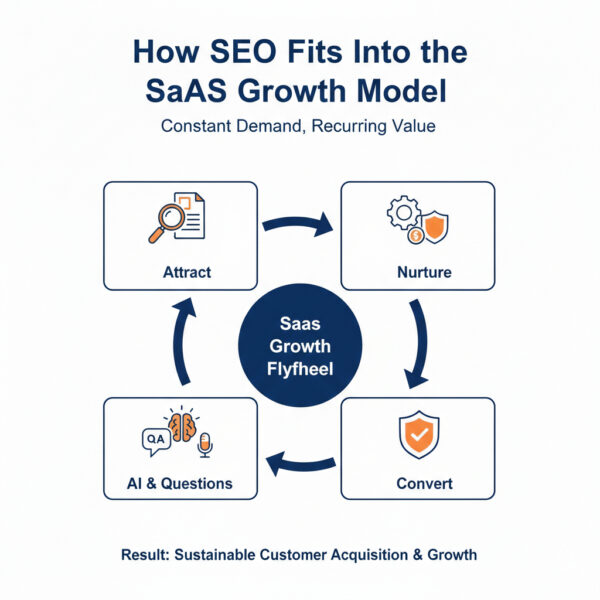
SEO is a natural partner of the SaaS business model, with its focus on steady demand rather than one-time transactions. Consider all those swarms of recurring signups, and long-lived customer values that keep rippling out into the future. In support of this kind activity, SEO produces constant visibility throughout customer engagement, right from the moment they first open their browser window to when they buy or leave your store.
SaaS buyers do not usually make an immediate purchase. They investigate their problems, explore what solutions there are at all, compare tools against one another and evaluate the various features before they eventually seal the deal. SEO lets a SaaS company present itself during any of these stages through content that is intended to attract and bump up product pages. This repeated exposure accumulates respect over time.
Further, SEO complements the rest of SaaS business growth channels. Paid campaigns may introduce a SaaS product to new markets or user groups yet SEO provides further information and service after they have tried out the interface on an Internet search site. This balance reduces a company’s reliance on short-term campaigns and establishes a smooth acquisition process.
With SaaS, as the platform grows so does SEO’s impact. Every new page, feature update or scenario usage presents another chance to draw in exactly the user you need. Over time SEO matures from a fragmentary cross-functional measure towards being a solid pillar of the SaaS growth model itself.
3. SEO as a Scalable User Acquisition Channel for SaaS
Scalability is the key factor for the sustainable growth of a SaaS tool. Without increasing the cost to acquire a user, the more users you get, the better. SEO meets this demand by building an asset that appreciates over time, rather than being forced back to zero each time campaigns are run.
SEO, as distinct from paid acquisition, does not depend on constant payouts to be maintained. Once a SaaS website has achieved rankings for relevant search phrases, it can attract users continuously and at no additional cost per click. This makes SEO one of the rare acquisition channels which actually becomes more efficient as you go up the scale.
At the same time SEO is also a powerful tool for Saa S vendors so make fl during the growth phase to expand into new markets and use cases. In step with a product’s evolution, different functions, interfacing software and industries can be reached through search. Each new page inserts more “power creating work” without diminishing how well existing pages perform.
In SEO, scalability is achieved through accumulation. Content, authority and technical robustness all build upon themselves. As trust grows, new pages rank faster and need less effort to reach visibility. This in turn means that a SaaS business can increase acquisition volume without taking on an unexpected spike in costs.
Eventually SEO becomes more effective as the product matures. Instead of chasing users, the company is in a position where users are actually looking for them at just the right time.
4. Search Intent and the SaaS Buyer Journey
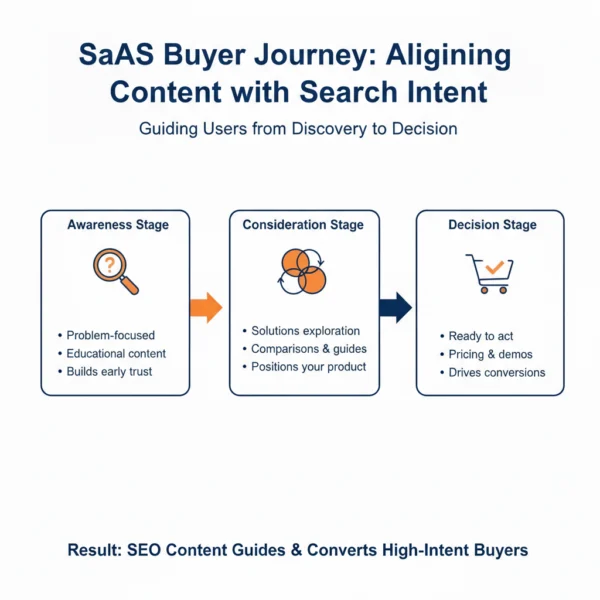
SaaS buyers follow a structured decision process that can unfold over time. Rarely do they move from discovery to sign up immediately. The SEO content should be in line with search intent so as to help establish the SaaS brand as a popular resource for information. And it works.
Awareness Stage
At the awareness stage users are identifying problems not solutions. Searches usually revolve around what people are experiencing, whether there are any obstacles to be removed or ways in which they may feel more comfortable. SaaS content should educate rather than sell at this stage.
Typical awareness intent includes:
- Questions about standard problems
- Searches to explain processes or pains
- Requests for general advice
- Content that answers such queries not only helps to build the brand in its early days but also provides credibility.
Consideration Stage
During consideration users start to explore potential solutions. They compare tools, approaches and features. SEO content here is to explain how various solutions work and where your product fits in the spectrum.
Consideration intent usually involves:
- Comparisons of tools and techniques
- Features explained in Google
- Alternative evaluations
- This stage is crucial for positioning your SaaS product as an option.
Decision Stage
Decision-stage searches indicate that the buyer is ready for action. Users are looking at prices, trials, demos or actual implementation details. Pages optimized to reflect this kind of information should be easy and credible, with clear navigation to the conversion point.
Decision intent often includes:
- Product-specific searches
- Pricing and Plan queries
- Demo or trial queries
By aligning SEO content with each stage of the buyer journey, SaaS businesses can support users from first awareness to final conversion.
5. Content Strategy That Supports SaaS SEO
Content is king in SaaS SEO. It allows the product to be discovered across all kinds of customer applications, variants, and areas. To have a strong content strategy ensures that a SaaS platform remains in stock throughout the buyer journey, and not just at the checkout.
Product and Feature Pages
Product and feature pages are designed to tackle high intent searches. They must make clear what the software is for, who it serves and how many different unique problems have been solved by it. Properly optimized, they attract users who are ready to buy tools and therefore close conversion.
Clear narrative, structured content, and focused messages help search engines understand what is relevant and users appraise value quickly.
Solution Based and Use Case Content
Many SaaS buyers do not search by product name, they want to solve problems. Content targeting use cases, workflow patterns or industry specific issues helps find users deeper in the research phase. These pages connect their needs with how your software solves problems.
By looking at problems in detail rather than breadth, solution focused content can also increase topical authority.
Educational and Comparison Content
Educational content builds trust by addressing issues that people ask before they commit to a platform. Guides, tutorials, explainers all work together to reduce uncertainty and support a well-informed decision-making process. Comparison content helps users understand the difference between tools, not with hard sales language.
This kind of content provides a steady stream of traffic and helps drive conversions over time by linking internally to product and feature pages. A balanced SaaS content strategy ensures visibility, trust, and topical relevance all along the acquisition chain.
6. Technical SEO and Platform Performance for SaaS
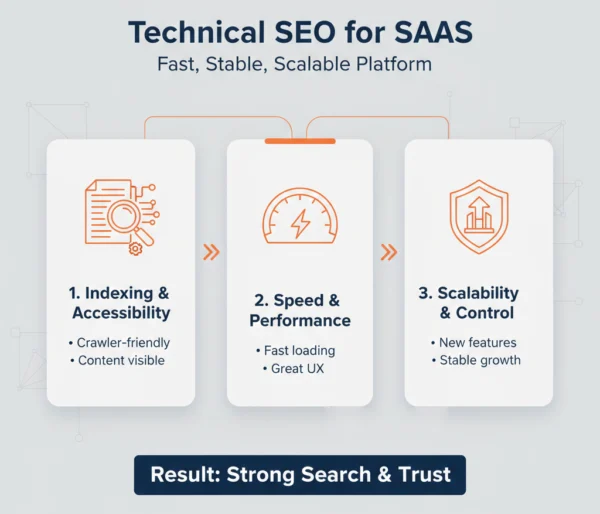
For SaaS companies, technical SEO is especially important because such platforms are often complex, dynamic, and sophisticated. Without search engines being able to access, understand, and judge the quality of web pages on a consistent basis, it is no longer possible for decentralized SEO to carry this much weight.
SaaS platforms often rely on JavaScript, dashboards, and dynamic content. If pages are not rendered correctly due to failure of search engines to spider them properly, even when a page is of high quality it may not show up on the first page for relevant queries. Technical SEO on the other hand ensures important pages are accessible and that core content is visible during crawling.
Performance is also important. Slow-loading pages create friction and decrease engagement, this is especially true when users are evaluating software options. Fast performance brings good user experiences. For SaaS websites, this includes optimization of scripts, management of third party tools and ensuring that page rendering stays stable.
Indexing control is another important aspect. SaaS platforms may create multiple URLs based on filters, parameters or user states. Technical SEO guides the search engines to the important pages while removing unnecessary copies or duplicates that could dilute your strength and authority
A good technical foundation underpins scaling. With the addition of new features, integrations, and content, SEO remains stable and predictable. Without this basis for growth introduces risk rather than opportunity.
7. SEO and Long Term Customer Acquisition Cost Reduction
Customer acquisition cost is a critical metric for SaaS businesses. Paid channels become less predictable and more expensive as competition increases. SEO can help bring higher organic traffic than rising spend on paid channels does for each new purchase.
When SEO is done correctly, the number of organic traffic to the website continues, and the cost stays comparatively stable. When pages rank well, they continue to attract visitors without any further investment in budget. Over time this gradually reduces the average cost of winning each customer, especially when compared with paid campaigns that must reset costs again with every click.
SEO also increases lead quality. People who come through search are generally active looking for solutions and evaluating alternatives. Because they are in demand to do real work their conversion rates are higher and retention times longer. This raises lifetime value. Greater lifetime value with lower acquisition costs boosts total returns.
SEO creates compound returns over time. As you gain authority, new pages rank quicker and take less effort to convert. Therefore SaaS companies can scale acquisition without giving up control over costs.
8. Measuring SEO Success for SaaS Businesses
In SaaS businesses, SEO performance should be measured by how effectively it supports sign-ups, trails, and revenue rather than by how much traffic alone is driven to a site. Visibility is important, but growth depends on whether organic users grow through the funnel and become customers.
SaaS SEO evaluation is about tying search activity into actual product actions: what content users see, how they locate your platform, and where conversions happen. When assessment lines up with business outcomes, SEO becomes easier to refine and scale.
Key Metrics That Matter for SaaS SEO
The most useful indicators combine both acquisition and value. For example:
- Organic traffic to product and solution pages
- Trial or demo signups from organic search
- Conversion rate of organic visitors
- Activation events after signup
- Revenue influenced by organic acquisition
These measurements can help demonstrate how SEO is delivering users who are likely to become long-term customers.
Traffic Versus SaaS Growth Outcomes
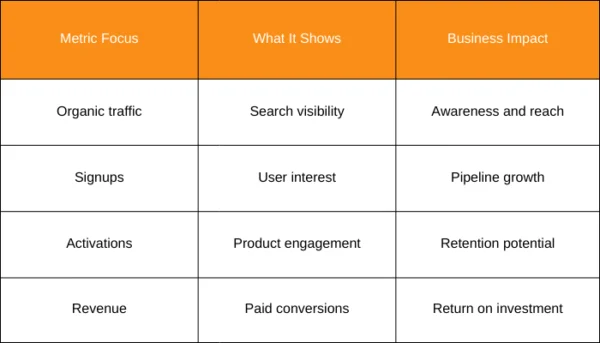
This comparison highlights why SaaS SEO should be evaluated beyond rankings.
Using SEO Data to Improve Growth
SEO data should guide iteration. Pages that attract traffic but generate few signups may need clearer value messaging or stronger calls to action. Pages that convert well can be expanded with related content to capture more demand. Regular review ensures that SEO remains aligned with product positioning and growth goals.
9. Common SEO Mistakes SaaS Companies Make
Many SaaS companies put in the time and effort for SEO but still effectively take it in the face because of a wrong guess at the first blow. These strategies are often derived from treating search engine optimization as a quick shot in the arm rather than a long term growth system.
One common mistake is to only focus on trademarked or product name keywords. Though those types of searches are usually conversed well, it will restrict your audience base to people who already know the product. If you overlook problem-centric or solution focused searches you are essentially turning off your earliest stage buyer traffic.
And there is a third drawback: the lack of content depth. Pages that list features such as before and after pictures without discussing the value in short, thin content. SaaS buyers demand clarity, comparison and detailed explanations. But without that sophistication, the page does not win trust or rank.
Technical complexity can be an issue as well. SaaS platforms often introduce dynamic elements which affect crawlability and indexing. If technical SEO isn’t properly performed early on, growth is only going to bring more problems along with visibility.
Finally, many SaaS companies measure SEO only by rankings and traffic, ‘forgetting’ that it’s also important to keep track of sign ups, activations and revenue. Unless these are monitored, real performance is difficult to understand or justify continued investment. Avoiding these mistakes leads to a compounding of SEO efforts instead of stagnation.
10. Conclusion:
SEO helps SaaS businesses secure sustainable growth in competitive markets. Against user needs, SaaS SEO makes it easier for targeting and emitting signals in ideal spots where users can be found; Or stuffing themselves into every part of the customer experience from beginning to end does not create long-term demand, but only temporary spikes in traffic.
where executed correctly SEO lessens reliance on paid acquisition, reduces customer acquisition costs, and brings in intermediate users. As content, authority and technical strength compound over time, growth becomes not only smarter than sweat but scalable too.
For SaaS businesses, SEO is not a side dish. The overriding growth engine drives visibility, trust and long-term revenue for the firm itself. As an ongoing investment, treating SEO in this way helps ensure that companies can continue to be discovered well into the future.
Are you struggling to get more traffic?
Run a free SEO analysis to uncover site issues, competitor gaps, and ranking opportunities.