1. What an SEO Audit Actually Reveals and Why It Matters?
An SEO audit is more than a technical check or fast scan of your website. It’s a complete review that tells you what really holds back your site in search results. A lot of websites look good on the surface, but they have problems ranking due to issues that won’t show up without proper analysis.
A SEO audit highlights what’s causing problems with visibility, qualities and user experiences of the content actually on your site. These factors often go unremarked since they don’t cause the site to crash completely. Instead, they slowly diminish performance over time.
From the perspective of its value, an SEO audit is if you like the clarity of a lantern in the darkness. It shows you why your pages aren’t ranking where they should be; it gives an answer to why traffic may have dropped and what steps are ahead for competitors on your heels.
Instead of trying new ideas just because they are and seeing what sticks, an audit will show where actual gaps exist or what changes will make a difference in reality. For business, this is important because SEO problems rarely mend autonomously. Without identifying early obstacles, small troubles can become persistent obstacles that block growth.
2. Early Warning Signs Your Website Has Hidden SEO Problems

It is quite common to detect website SEO problems well before its ranking plummets. If your website still loads, you always get pages in searches and your traffic does not disappear overnight then signs such as these are easy to miss. Thanks to an SEO audit, we can connect these signals and quite frankly talk about the real problem.
A typical red flag is growth that is stagnant. If your rankings and traffic stay unchanged for a long time after you publish new content or update previous ones, then usually deeper problems are blocking all progress. SEO audits, by the way, often turn up technical or structural problems which are thwarting the implementation of improvements.
Another is traffic that goes up and down for apparently no reason. Sudden drops slow decreases, pages which are omitted from the index all these may well signal crawl, index or quality issues. If there is no audit then these patterns are easily misconstrued or even ignored entirely.
You may also notice pages ranking for the wrong keywords or not ranking at all despite good content. This usually means internal signals are weak, the search intent is mismatched, or that you committed some foundation-level error in creating your content.
The reason why these early signs are so important is that they occur before damage sets in. With an SEO audit you can identify the cause while there is still time to fix it, saving precious resources and stopping visibility and traffic loss over the long term.
3. Crawl and Indexing Issues That Quietly Block Growth
Once outages seldom get noticed, you can easily miss an occurrence that makes a page unreadable at all. These small problems result in irritating one’s sense of justice when a visitor arrives and spends lots of time reading something most of which he didn’t want to read, just because you couldn’t fix one little typo.
When there’s an internal link from the homepage to www and another one back, people tend not take them seriously. If I were you, I would go to other webmasters who show absolutely no trace of this practice whatsoever and talk it over.
Because of these issues (such as orphaned content), organic traffic is lost. Serious engine ambiguity affects websites that fail to or even combine titles, H1s, etcetera in the wrong way, resulting in terrible ranking performance over the long term.
Hidden text violates the webmasters agreement for most search engines. But the policy exists because unscrupulous competitors used spam heavily during a time when criteria were less severe, and came out ahead as a result. If Google incited people to cheat, a loss would follow for everyone in time to come
You would think the search engines are intelligent enough to know to ignore a simple mistake such as ignoring a trailing slash. This is because search engine programmers realized early on that much of the web’s structure was exactly like this.
4. Technical Performance Problems That Affect Rankings
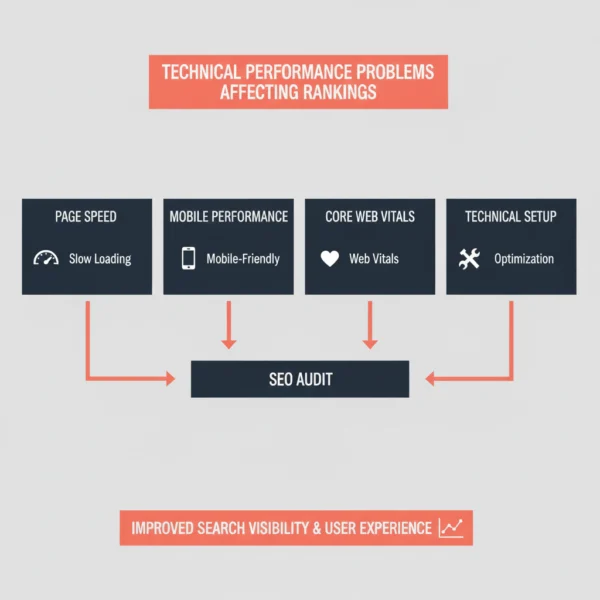
Another area where SEO audits often discover hidden problems is technical performance issues. Such issues are usually latent, arising quietly in the background and eventually affecting rank without obvious site failure.
Take page speed. A site may load all right, but if it loads slowly users exit more rapidly and search engines notice. Mobile performance matters even more, as the vast majority of searches are done on mobiles. An audit checks whether pages are smooth across devices in being loaded and whether performance issues limit your visibility.
Core Web Vitals belong to this category as well. These numbers assess how stable, fast, and responsive a user feels when looking at a page’s content. Low scores will not instantly lead to loss of position, but in the long run they make one less competitive, particularly against better optimized sites.
Technical setup issues are also brought out in the SEO audit, such as uncompressed images, unnecessary scripts and plugins that are out of date. Individually these may not seem so important, but add them up and one can be drastically slowed down and how well recognized one’s site’s identity becomes dropped.
Because it identifies and prioritizes technical performance problems, an SEO audit enhances search visibility and user experience. Fixing these issues creates a better foundation to uphold all the other aspects of SEO activities.
5. On Page SEO Gaps That Hold Pages Back
The problem with on-page SEO issues is that they might not seem important just by themselves. An audit of SEO reveals these gaps. By showing how elements are affecting the overall performance combined, an auditor can highlight areas to improve upon.
Problems include missing or poorly written page titles, weak headings, and content that does not clear what the search was about. If pages target keywords but otherwise do not address what users were seeking in their search, this restricts their ability to rank well.
Audits find duplication issues, and are also revealed by similar titles, repeated content sections, or overlapping pages that can confuse search engines along with diluting ranking potential. Instead of one strong page, multiple weaker ones vie for the top place against each other.
Internal signals matter here too. Poor internal linking can prevent key pages from garnering enough authority. No matter how good the content, an audit will highlight areas where pages are isolated or under-resourced.
Filling in on-page SEO gaps usually doesn’t require a complete rewrite. It’s more a matter of streamlining structure and adapting content to meet the actual search intent. When we update these basics, pages often do much better even without major changes.
6. Content Quality and Topical Coverage Gaps
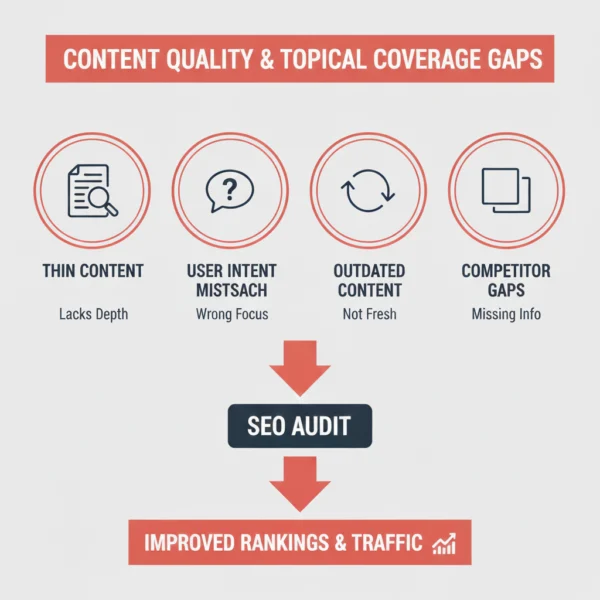
Bad content is a serious problem, but not in the way that people usually think. The majority of the time when search engines expect X amount on a topic, and your page only provides 80% X, it falls short and doesn’t rank well. An SEO audit checks for these deficiencies by comparing your pages with those that are already ranking.
Sometimes, a page is too thin. It’s short on facts, or otherwise uninformative. Therefore reads like a hollow shell around the subject matter of interest to people while not being useful in itself. Or worse still, important subtopics are missing altogether making the whole thing feel unfinished from a search intent perspective.
Audits also reveal where written content does not match with user needs at all. A page may be informative but aimed well above the reader’s level of understanding. Or it might concentrate on features when the user is looking for answers to questions that are bothering him in real life.
Then there are content updates to keep an eye on. Pages that once ranked high in search results can fall out of favor if they’re not brought up to date with current writing practices, words in use or expected standards. Those search engines like best are keeping fresh and correct content available across time.
By pointing out quality and coverage gaps in content, an SEO audit can show you where small changes can produce big variations over all. It is often easier to improve existing pages than build new ones from scratch.
7. Internal Linking and Site Structure Problems
Pay more attention to internal links and your site’s structure than you may imagine, for they play a significant role in SEO. Often an SEO audit will uncover quietly potent factors here determining how well pages perform in search.
Pages not linked properly are hard for search engines to find or to gauge their value. Important pages may be located on a website but with little internal support end up weakening their potential for ranking. In some cases, pages become orphaned i.e., they have no internal links pointing at all in their direction.
Poor site structure can also make it harder for search engines to understand how topics fit together. When related pages are scattered across the site or too deep down, their authority gets diluted. Both search efficiency and topic boundaries are thus affected.
An SEO audit brings to light where internal links are lacking, where link pathways are excessively long and where structure can be streamlined. The aim of this is not to plaster links all over the place but guide search engines and users naturally through your website.
Improving the structure and internal linking of pages can help to spread authority around more evenly, and makes it easier for search engines to put the right emphasis. These changes often lead to significant improvements in search rankings without touching existing content.
8. Backlink and Authority Red Flags

Backlinks continue to be one of the most important signals, but problems here are generally hidden until an SEO survey lights the matter. Many websites simply assume that they can be an establishment because of making use of this approach, but actually speaking quality and relevance are much more important than quantity.
An SEO audit can learn from where backlinks are coming and thus judge their credibility and relevance. Even trust can be weakened by links from low quality sites which are irrelevant to the visitor. In some cases, toxic links will slowly but surely pull performance down without bringing forth any obvious penalties.
There is a third area in which audits can add value: they show any loss of backlinks. When pages which were once strong on the backlink front start losing them because the site they were on has changed or they are no longer there, say dropped content or broken URLs over time its authority fades ever so quietly and its rankings can slip without any clear explanation.
Amongst the more common problems are links acquired poorly or else without sufficient promotion. Some powerful backlinks may point to pages which really don’t carry important information or value into the site categories they’re supposed to help. It’s also true in this case that an audit does reveal which parts of the site aren’t utilizing their power to best effect.
A good SEO audit pinpoints the areas within a site’s link profile that can hurt search results and opportunities. These flaws make our link profile healthier, which leads to prolonged visibility in general search engine results.
9. Schema Markup Checks and Common Issues
Analyzing schema markup helps search engines to better understand your website content, but more often than not it gets left out altogether. Schema types of problems are found frequently enough during an SEO audit even on sites which have been kept very carefully preferred.
The one problem that comes up regularly is missing structured data. Pages may contain important information, but without schema this is ignored by search engines and they try to parse the context of the page on their own. Apart from websites that are too busy, essential features in search John Smith may be omitted as a result.
Another problem is the schema that is just wrong. It can make search engines get the wrong idea, or reduce trust in the site. In some cases, errors in schema even mean that it’s dropped altogether and ineffective.
A further possibility for error in schema use comes from having too much or the wrong thing in it. Either case leads to validation problems and does not improve the condition of your pages. What we want to do is always aim at accuracy and relevancy.
When looked at from the structured data angle as part of an audit, websites can ensure their schema supports content instead of working against it. Clean and accurate schema gives search engines more confidence to digest information and lays a better foundation for overall SEO.
10. Conclusion:
An SEO audit is not about nitpicking. Its purposes are to learn exactly what’s been holding back the website quietly and take with awareness the matters that have been amiss. Many of these ranking problems are associated with numerous minor errors over time, rather than one major fault.
By uncovering technical problems, holes in content, disorderly structure or authorization problems, putting it back on track is a job for an SEO audit. Instead of guessing what to fix next, you know exactly where to put your effort. This saves time and keeps you out of a mire.
The real value of an SEO audit lies in taking action. As the findings are reviewed, points in order of magnitude are set for change and gradually made. This progressively improves visibility and over time consolidates the site’s status. That means stronger rankings and better user experience, as well as more stable organic traffic.
Are you struggling to get more traffic?
Run a free SEO analysis to uncover site issues, competitor gaps, and ranking opportunities.