1. Why Google Maps Rankings Matter for Local Businesses
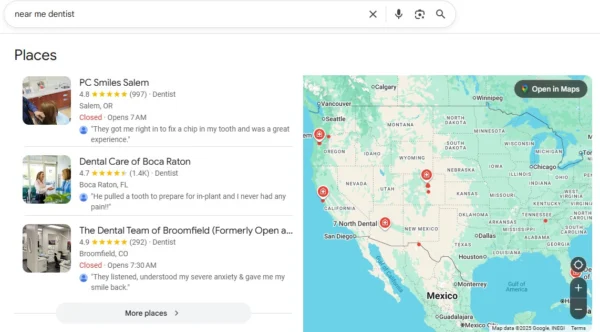
If you need a service nearby, Google Maps is usually the first place people turn. Whether you are after food, medical care, or a repair service be delivered; they only want fast information with a few clicks, directions to the place of business and people you can trust to do an honest job. It is for this precise reason that ranking upward in Google Maps is so important to brick-and-mortar businesses.
Higher rankings on Google Maps mean your business comes up before competitors. It also means more phone calls, more walks-in and real-life customers coming through the door. Since most users don’t scroll down very far or look through too many options, they simply pick something from what is shown at the top by Google.
Local SEO is largely responsible for this. It helps Google know where your business is located, what it does, and why it should show up in local searches. If local SEO is well done, it not only means increased visibility but also links a you-and-me type of business with people who are already looking for what you have to offer where we live together here right under our noses.
This part sets the stage for understanding the direct impact of local SEO on Google Maps rankings and why it is such a critical growth driver to businesses whose market is primarily local.
2. How Google Maps Rankings Work in Local SEO
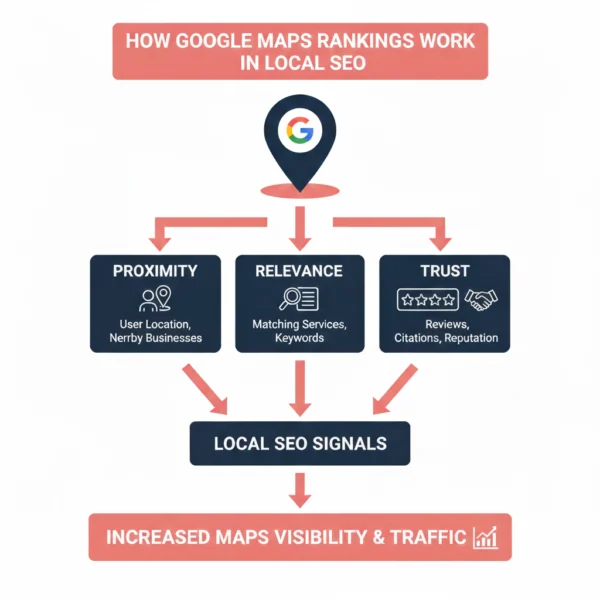
Google Maps rankings around the world are not arbitrary or capricious: they’re based on a host of local signals that help Google decide which companies are the best fit for any given search by a user. When people type searches like “near me dentist” and “best coffee shop,” Google tries to show results (in both cases) both useful and nearby where a user might be located.
At its most basic level, Google Maps makes local intent its main focus. It looks where the user is situated and lines up with businesses that match his search. Then, it evaluates each business ‘value for the query and the trustworthiness inherent in information about those businesses online.
Local SEO influences such signals, because it puts clear information about your business location, services and reputation in front of Google. Without good local SEO, even if you are in close proximity to the person searching, it can be difficult for Google to truly understand your business.
This is why businesses which have good local SEO often outrank their competitors on Google Maps – and that ‘even without putting time into pay-per-click advertising. Google prefers companies offering real information, relevance in a particular locality, and actual customer engagement.
Understanding how Google Maps ranks pages helps one to see why local SEO isn’t optional. Instead, it acts as legwork for Google enabling them to know about, assess and even promote your business in the local search results within their web-tools.
3. Google Business Profile Optimization and Its Role in Maps Rankings
The Google Business Profile is one of the major factors that affect your Google Maps rankings. When it comes to local results, the business profile is also typically the first place where Google goes to find out what you’re all about.
A fully optimized profile aids in helping Google to see clearly what your business does, where it operates, and who it serves. Without such fully optimized profiles, Google does not feel confident about presenting your business at the top rankings no matter how much effort you put into other optimization aspects.
Optimization starts with the basics. The name, address and phone number of your business must be correct. Primary category selection is particularly important for this stage because it influences which searches from now on your business will appear.
The best performance usually comes from active profiles. Filling in many basic facts of your hours, services and photographs gives a signal that this is a legitimate business well kept up since opening. Customer actions such as calls, directions requests and profile visits also add visibility over time.
Local SEO is all about making sure that your Google Business Profile is consistent with your website, local signals, and other related parts of the Internet. When things hang together in this way, it’s easier for Google to give you a high ranking in its maps for relevant keywords.
4. Business Relevance, Proximity, and Prominence Explained Simply
Google Maps rankings are heavily influenced by three main factors: relevance, proximity, and prominence. When these are evaluated, they decide whether or not your company deserves to come up first for a local search.
Relevance is how And if your services, categories, and descriptions are clearly consistent with what the user is looking for, Google will be more likely to show your business. Local SEO will help boost relevance by aligning your listings with real, actual local searches.
Proximity refers to Your business is located in relation to the user’s location. can’t control where a user is by You can however ensure that your business address is accurate and properly verified so Google can calculate distance to it accurately.
Prominence means Google is looking to see how well-known and what kind of authority you have online. Things like the reviews, ratings, mentions across the web and general activity can give it a signal of prominence.
Local SEO works by making all three efforts stronger at once. When your business is very clearly relevant, in the right location, and trusted by users, Google Maps rankings will naturally go up.
5. How Reviews and User Engagement Influence Google Maps Visibility
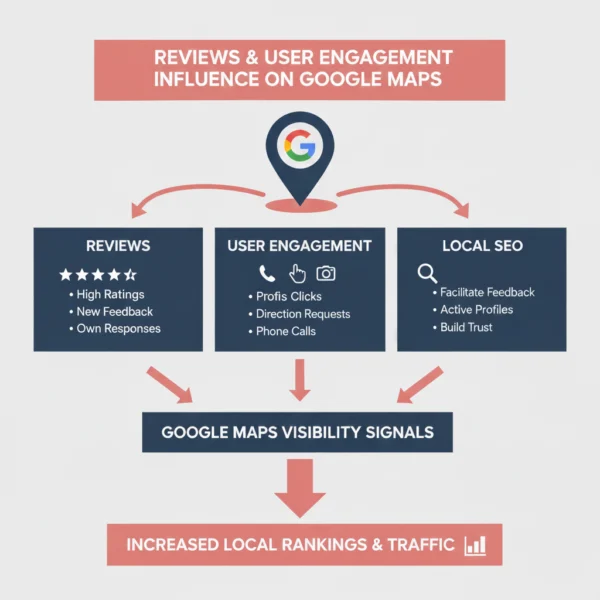
Reviews play a major role in how businesses appear on Google Maps. They help Google understand whether people actually trust and choose a business. A steady flow of genuine reviews signals that a business is active and relevant in its local area.
It is not just about having a high rating. Google also looks at how recent the reviews are, how often new ones come in, and how users interact with the business profile. Businesses that receive regular feedback tend to stay more visible than those with old or inactive reviews.
User engagement matters just as much. Actions like clicking on the profile, requesting directions, calling the business, or viewing photos all send positive signals. These actions show Google that users find the business useful and worth engaging with.
Local SEO encourages healthy review practices by making it easier for customers to leave feedback and by keeping profiles active and accurate. Responding to reviews, both positive and negative, also helps build trust and shows that the business values its customers.
When reviews and engagement are consistent, Google is more confident in ranking a business higher on Google Maps for local searches.
6. The Importance of NAP Consistency for Local SEO
NAP is short for name, address, and phone number. These data seem simple, but they have a vital role to play in local SEO and Google Maps rankings. Google uses this information to confirm your business is real and situated where you are certain it is.
When your NAP is the same as that on your web site, Google Business Profile, and other online listings, trust is generated. Inconsistent details may confuse Google and reduce the chance of ranking higher on Google Maps.
Even small details are important. Changes in business name, old addresses, or wrongly entered phone numbers can give differing messages out to both Google and users. Over a period of time, this will reduce rankings particularly in well-fought local areas.
Local SEO is about cleaning up and maintaining accurate out of place information in all the places where your business appears online. Meeting this consistency makes it easier for Google to connect all those local signals and treat them as one verified business entity.
Strong NAP consistency makes it easier for Google to confidently show your business to nearby customers who are looking for your services.
7. How Local Citations Support Higher Google Maps Rankings
Local citations refer to online expressions of your business name, address, and phone number from the Internet directories, local listing sites, and platforms. These citations help Google confirm the information of your business beyond your own website or Google Business Profile.
The more reputable stores you are in local directories that Google trusts, the greater its confidence in the fact you are operating from a real location. For Google Maps the latter is particularly crucial; inaccuracies and suspicions play a big role in rankings.
Quality is more important than quantity. Citations from better-known directories carry more weight than random ones or low-quality listings that can clog up the results page. Each accurate citation is more than just a helpful vote; it also throws off a subtly confirming signal.
Local SEO saw the birth and growth of citations when accurate it makes these correctly. This ensures data is copied and pasted directly from one place into the Web platform without any errors.
Strong signals from citations help the “eyes” of Google to see that this company is really excellent, making it more likely that you will find it ranked high when doing local searches in Google Maps.
8. Website and On Page Local SEO Signals That Affect Google Maps
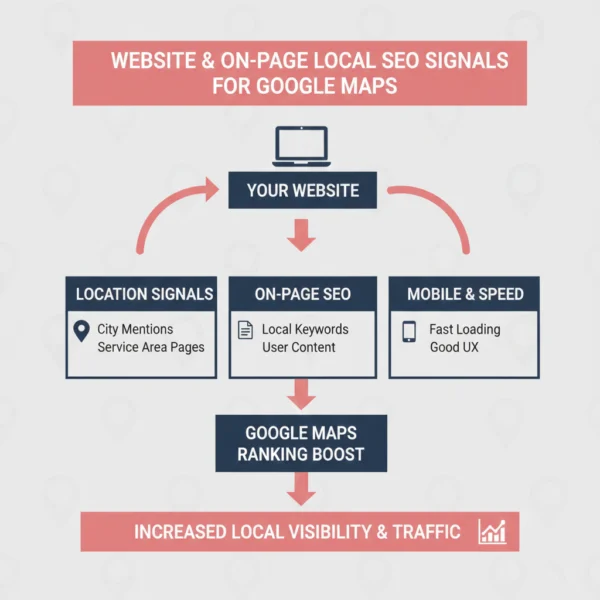
Though the results appear inside Maps now, your website still plays an important role in Google Maps rankings. For this purpose Google not only needs your website’s proprietary content (photos, descriptions), but also uses a data layer on the top of this website to confirm what your business is giving away and how it relates to local search intent.
Clear location signals do help. Your website should naturally mention your city or service area within key pages, especially the homepage and service pages. This helps Google connect your website with your Google Business Profile and local listings.
In addition to your backlink profile, basic on page SEO elements also make a major difference. Page titles, headings, and content should clearly explain your services in a local context. This does not mean forcing keywords. It means writing in a way that clearly answers what you do and who you serve.
A fast, mobile friendly website improves user experience, which indirectly supports local SEO. Since many Google Maps searches happen on mobile devices, you’ll get points if yours isn’t a slow site to load or if it features useful content. Remember: Google ranks businesses whose websites load quickly and work smoothly on phones compared to those that don’t.
When your website supports your local signals instead of conflicting with them, Google Maps rankings become easier to achieve and maintain.
9. Using Local Business Schema Markup to Strengthen Maps Presence
Schema markup enables search engines to better understand your business information. It directly affects local SEO. Through local SEO, this is an added layer of confirmation that backs up your Google Maps visibility.
Local business schema enables you to show important data such as the company name, address, phone number, business style and office hours in a structured way. It makes it easier for Google to read and trust your data without guessing.
Although schema markup does not directly push rankings overnight, it strengthens the overall foundation of local SEO. When Google sees the same accurate information across your website, Google Business Profile and schema markup, it is more confident in your business entity.
Schema even serves as support for answer engines. It helps your content get organized so it is easier to read for featured answers and local search summaries. This is particularly significant for location based searches where clarity counts.
For any business that wants to strengthen its Google Maps presence and thus avoid data mismatches holding back visibility, adding local business schema is a wise step.
10. Conclusion:
If your information is always up to date, you have clear signals that help Google understand your enterprise and trust it. Local SEO integrates all of these signals in a way which feels natural to human beings and suits their methods of searching.
With business profiles you can expect more visibility on Google Maps if the information is consistent, your homepage supports local intent, and your customers interact with you. This new visibility in turn generates extra calls, more walk-ins and real customers within your vicinity who are already looking for what your business offers.
Local SEO isn’t just a one-off. It’s a long-term process for companies to continue being relevant in their local market as search behavior changes. For companies that rely on their local customers, investment in local SEO is one satisfying way to convert online visibility into sustained growth.
Are you struggling to get more traffic?
Run a free SEO analysis to uncover site issues, competitor gaps, and ranking opportunities.