Why On-Page SEO Still Matters for Business Growth
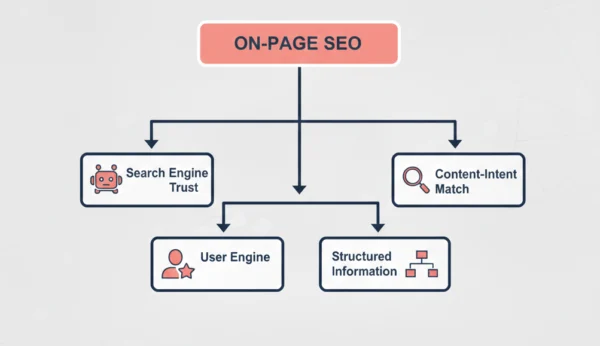
While On-page SEO has been sneered at outdated long to this day it even continues to play a central part in online businesses growth. But the reason is straightforward. No matter how search engines change their algorithms, they still depend on page level signals to make sense of relevance, quality and confidence in business.Remarkably, they can not judge any company without solidly ‘interpreting’ what happens on its pages in the first place.
For businesses, growth doesn’t come simply from rankings. It comes from being understood, trusted, and selected.On-page SEO serves as a direct venue for all three. It decides how search engines present your content to their clients; and how readers find themselves experiencing that presentation once it’s been found. A page that answers questions clearly; follows logical structures; and can show credibility in essence is much more likely than not to turn visits into measuring up if not actual business results.
Modern on-page SEO is no longer concerned with placing keywords in the most obvious places. Rather it is about connecting content to intent, organizing information so that it is easy to absorb and indicating expertise in a way that feels both natural and human.When all of these work together, they result in pages where users are going well treated by the search engines and can support decision making dressed up as business all at once.
Businesses that ignore on-page SEO may think that backlinks or paid traffic are enough by themselves to facilitate growth. But in fact, a lack of strong on-page bases hampers the effectiveness of every other channel.Other hand, strong pages amplify one’s profile, build up trust and convert eyeballs attention into quantifiable results.
This is why on-page SEO is as crucial as ever. It may not be a turnkey strategy designed to check things off, but rather a fundamental means of growing business that links search exposure with actual performance.
How On-Page SEO Aligns Search Engines With User Intent
With every search, there is also the intention behind it. Not everyone just throws words up on a search bar. They are trying to solve a problem, feel satisfied, make a decision or take advantage of better understanding. On-page SEO is a means of ensuring that search engines correctly understand this intention and can connect it with similar content. Without strong on-page signals, even well written pages fail to capture the right audience.
Every element of a web page will be analysed by search engines. It will understand the true theme of this page from an introductory manner, logic used to develop ideas to the content presentation’s level of clarity. Good on-page SEO takes away uncertainty. It helps algorithms to differentiate between informational intention, commercial intention and transaction intention. This has a direct bearing on whether a page will come up for early research searches or high value decision accuracy requests.
This alignment is crucial for businesses. When intention and content are not in harmony, engagement is poor. Users leave, conversion rates drop, and in due course rankings decline over time. On-page SEO ensures that pages are set up to meet expectations at exactly the point in the buyer’s or user’s journey where they occur. A knowledge page is expected to lead to understanding. A service page should remove doubt. A comparison page will help the customer to decide with confidence.
It’s self-evident that alignment of intention also improves the performance of content across modern search experiences. Featured snippets, People Also Ask results, and answer engine responses all thrive on content that’s clear in intent. Pages that are clear and organized are more likely to be chosen as the trusted answer.
Today’s algorithms, which emphasize relativity over repetition, make intention the linchpin of visibility. With on-page SEO we feed human needs to search engines in language that they derive meaning from. When this translation is done properly, businesses don’t attract traffic only. They attract the right traffic, which is the very thing that drives growth.
The Evolution of On-Page SEO Beyond Keywords
When Keyword-First Optimization No Longer Works
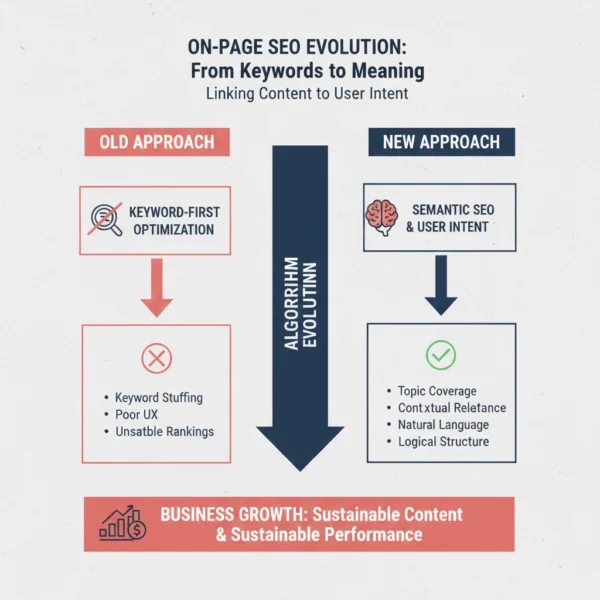
At the outset, on-page SEO just meant making sure your keywords appeared exactly. On-page SEO began with placing keywords exactly. Pages were put together to match search queries word for word. This has often come at the cost of clarity and user-friendliness. It worked so long as search engines operated on literal matching, but today’s algorithms take a much more sophisticated attitude towards what makes content relevant. Today, relevance is judged from meaning not repetition.
Today search engines ask whether a page really addresses a topic.They consider the introduction, development and logical follow-up of ideas. pages that only rely upon keywords for their worth, without being profound and deep will tend to fail ranking. They do not demonstrate understanding. For businesses, this is a transition that surface-level optimization in all likelihood will not maintain sustainable growth any longer.
How Search Engines Interpret Page Meaning Today
The latest algorithms analyze relations between ideas, rather as is found in natural language, rather than at all in isolated terms. They look for contextual signals that indicate what “exitity” is about; and how completely the page covers that topic. This includes how supporting topics are treated, whether the explanations go forward in logical fashion and if it matches real-world language rhythm.
For example, a page optimized around a service should not consist just of what the service is called. It should provide a reason for existence or function, for which it benefits those who have this kind of needs; what problems it solves and what users can expect afterwards. When these elements are present, search engines will be much more confident in the relevance of the page.
Semantic Understanding Replaces Mechanical Optimization
Semantic SEO focuses on intent, entities and topic relevance. The problem now is not what keyword to place, but whether a page fully answers the root question behind any search. This is where businesses can have an edge. pages written for understanding naturally perform better across a wider range of queries.
At this point, a single bullet-list clearly shows what modern on-page SEO actually evaluates:
- Topic coverage rather than keyword frequency
- Contextual relevance between related concepts
- Natural language that reflects user intent
- Depth and clarity of explanation
- Logical structure that supports comprehension
Why This Evolution Directly Impacts Business Growth
When on-page SEO moves beyond keywords, pages become more durable assets. They rank for more variations, engage users longer, and require fewer rewrites as algorithms evolve. This creates a compounding effect. Strong pages support authority, trust, and conversions at the same time.
For businesses, this evolution means on-page SEO is no longer a technical checkbox. It is a strategic tool that aligns content with how people search, think, and decide. Pages built around meaning, not manipulation, are the ones that continue driving growth.
E-E-A-T and On-Page SEO: Building Trust at the Page Level
Why E-E-A-T Has Become So Important in On-Page SEO
Experience, expertise, authority and trust are no longer just ideas. Search engines have been actually honing in on tangible indicators since as early as the rankbrain era. They are measures that are connected closely with specific Web page criteria. Search engines want to know that a page is authored by someone who grasps the topic at hand, has actual experience with it, and can be counted on for reliability. The implementation of the strategy is where all these signals come into play. Absent them, even well optimized pages struggle to stay visible.
Signals of Experience Show Real World Understanding
Experience is manifested by tangible examples and real-world content. Pages which reflect experience “on the ground” tend to have actual explanations, actual hands-on examples and clear goals, objective descriptions of success that users can follow. This lets both search engines and users know that the content has “nitty gritty” on the ground reality. It is not high-level theory. This too dispels skepticism in business, particularly if the company is involved in a competitive or high-consideration field.
Expertise Is Expressed Through Depth And Precision
Expertise does not have to be declared. It can be shown. Pages that clearly explain concepts, avoid oversimplification, and use the correct jargon communicate knowledge of the subject and some degree of authority. That does not mean content should sound ‘academic’. It should sound competent. If explanations anticipate follow-up questions’ and other natural developments, the expertise speaks for itself without appearing to be forced.
Authority Is Reinforced By Consistency and Context
Authority grows when pages are in sync with a larger site narrative. Congruence in terminology, unified messaging across associated pages and internal links that support main topic areas all build authority. Search engines see these elements as signs that the company is the author of the topic, not a borrower.
Trust Is Born From Clear Communication and Sincerity
Trust is established when pages openly tell you where their limits are, what their results have been and what you can expect. To promise too much destroys credibility. “- Pages that describe processes, risks, or next steps in detail reduce fears and make people less likely to resist change. However, it does not matter how well a site meets these final touchpoints if the balance is awry at earlier stages where it counts most: This does not matter how well a site meets those last two points in a website’s interaction but does not happen.
E-E-A-T Strengthens Search Rankings and Business Conversions Together
Strong E-E-A-T signals not only game the system for how Pages are appraised in search engines, it also heightens the way in which users respond. More authoritative-looking pages tend to get read more and shared more frequently (if legit), for businesses tallies of page views were of greater importance than revenue. Thus on-page SEO evolves into something that will aid not only rate ranking but also operate for a brand’s long-term performance: a trust-building system itself.
Engagement Signals and Their Impact on On-Page SEO
So why engagement signals matter now more than ever
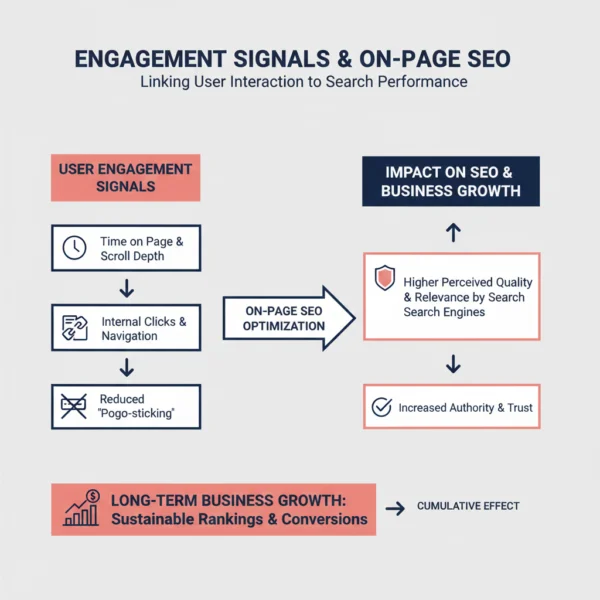
Given that engagement signals are always about how users interact with a page once there, and search engines do not measure direct human satisfaction. But search engines observe patterns of use that can help them judge or indicate whether a page is valuable. Algorithms of search engines combine these behaviors with other variables such as time spent on page, navigation behaviors and interaction depth in order to infer quality. These signals are established by on-page SEO: shaping the layout of content so it can be quickly consumed and presented.
The longer sites spend online and the more naturally visitors move between pages, indicates a successful outcome. When they disappear quickly or do not interact at all it generally means that content was not aligned with expectations. Over time these patterns of behavior increase human confidence in search engine rankings.
The formations of well-structured pages pay particular attention to the reader and clearly guide them. Introductions are made in a manner of clear and easy-to-read headings On-page SEO supports this by ensuring that headings reflect real questions and each tomorrow’s body paragraph covers just one single idea that arose yesterday. If netizens can scan and understand a page quickly, they can expect better rates of continual reading.
When readers confront sloppy page structure without any clear direction leading them down where they should go next; a block of text that’s been suddenly bolded or misguided like headings for instance, then it inevitably feels like they are in quicksand. Users disengage and the performance of any content worsens, no matter how factually accurate it may be.
Engagement Signals that Show Page Quality
Engagement isn’t just one thing it is a whole pattern of behaviors making up an indication as to whether a page is valuable or not. An at a glance metric for the most important engagement signals influenced by on-page SEO is shown here: Time spent reading or interacting with the page
- Scroll depth and content consumption patterns
- Internal link clicks showing continued discovery
- Reduced pogo-sticking back to search result
- Engagements bridges relative with commercial results
High engagement rates do more than simply bolster a search engine position. The more users engage with a page, the greater is the likelihood that they will trust your brand and thus explore services offered by it or take one further step in this journey. Pages which can naturally absorb our interest carry greater power in this direction. As businesses know from experience how an upward cycle works, well engaged pages will frequently convert better, produce higher average tickets and generate more revenue in the long term. On-page SEO is an integral part of this cycle, making sure your content is not only visible but also actually helpful — all through its lifecycle.
Long-lasting Engagement Spells Long-term Page Value
Search engines are more responsive to pages that maintain a performance consistent over a long period as opposed to short-lived spikes in traffic followed by rapid falloff. Pages built on strong on-page SEO principles, however, will sustain this engagement over time and support their place in search results in the long run. This endurance is what gives on-page SEO the chance to take part directly in a company’s long-term development.
On-Page Technical Elements That Drive Performance
Why Technical On-Page SEO Still Matters to Rankings
Even if you have a well written piece of content, Search Engines still have trouble understanding or gaining access to it. These on-page technical components make it possible for content to be indexed, interpreted correctly, and ranked.
None of these elements work alone. They affect clarity, relevance, and crawl efficiency, all of which have a cumulative effect on a page’s long-term performance.Inner Linking
Search engines depend on technical signals to grasp the structure, importance, and associations of content. When those signals are varying or non-existent, websites become less searchable and visible than their content deserves.Although the greatest on-page indicator continues to be page titles, too.Consistent and accurate as it may be, in the end this information nonetheless matters.
Title Tags Shape First Impressions Along With Meta Descriptions
Title tags remain an on-page signal. They help search engines grasp the subject of a page and they influence which users click through. An accurately described title resonates with search intent and leaves no mistake about what to expect. Meta descriptions don’t influence rankings, only click behavior. If they reflect the content with precision, though, they capture much higher quality traffic.
Here, a little consistency is good. Titles and descriptions both should echo the topic, approach, and promise of value found on the page itself.
Heading Hierarchy Helps Users and Search Engines Move through Content
Using headings properly makes content an evident catalog. An H1 defines the main topic of the page. H2s and H3s break complex information down into smaller sections. This makes life easier for search engines by providing a map of what they are scanning.
Pages with clear heading structures usually perform well, as they reduce confusion and enhance understanding. This also makes things more accessible to the general public, indirectly benefiting engagement and trust.
Internal Linking Adds Flow to Crawls and Context to Content
Internal links sew pages together into semantic topic groups. They apportion authority across the site and guide users to related material. From an on-page perspective, internal linking bolsters anything to which it is connected, giving a thumbs-up for ease of scanning.
At this point, one bullet point set can describe the most important points of technical SEO that directly affect performance on a page:
- Title tags that are clear and reflect the searcher’s intent currently.
- Meta descriptions that capture user interest in what to click and browse next.
- Heading hierarchy following the outline of the content.
- And then one would be left over…
The higher ranked pages out there are those with a clean heading structure. By removing ambiguities in the information delivered their performance improves a lot. This is also a way to increase user engagement with a topic or piece of content so people feel more engaged by it over time.
Internal Links: A Critical Part Of Your Site’s Connection Slavery?
Creating links which point back into other parts of itself a website allows clusters of related topics to form. By doing so, authority becomes evenly spread across the whole. It also lets a user follow up on anything that catches his interest more conveniently.
On-page technical SEO doesn’t require constant fiddling. It is all about starting pages off on the right foot. As a result, pages using this method perform more consistently and need less modification as search engine algorithms adjust. For a business, this means that the site’s ranking is secure and survival doesn’t depend on reworking things every year after Google says something new.
User Experience as an On-Page Ranking and Conversion Factor
How User Experience Has Become an On-Page SEO Signal
Thus user experience is strictly bound up with SEO. Search engines are not simply judging whether a page is an appropriate answer to an information need. They are also evaluating whether the experience of using it supports its intended interpretation.
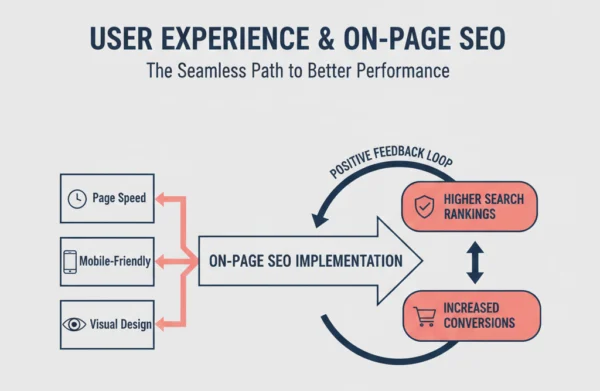
When a page feels straightforward, inviting and responsive, people stay longer and get more deeply involved in the content. This is not only an improvement for users, but also serves to underscore relevance and quality of a page right at a programming level.
Now, relevance and quality are increasingly important to companies. Organisation, navigation and visual design are all important for users moving from state of interest to action without a hitch.
Page Speed and Performance Create First Impressions
Page Speed is, for many users, the first experience signal they hit. Pages which load slowly will generate reader annoyance before the content is ever read. Reasonable load times immediately convey trust and let users focus on information instead of just waiting around for things to happen.
Performance is an effective way for search engines to sort through pages and decide which are good. Slow sites consistently correspond with low engagement metrics; by optimizing images, cutting out scripts which are never used for anything other than ad delivery and relegating most content to the sidebar, you give higher levels of visibility and usability to all.
Mobile Usability Decides Whether Content Can Be Read
The majority of searches now happen on mobile devices. On-page SEO needs to consider how content appears and behaves at these smaller scales: fonts should stay crispy without zooming. Buttons must be easy and friendly for tapping with fat fingers on a busy street. And moving from state A to C should be straightforward and natural relative to my expectation as a user.
When a page works well on mobile devices, it helps users in the crucial moments when they make decisions very quickly. This is particularly important for local businesses and businesses which provide services themselves–instances where accessibility directly affects one’s paycheck.
Layout and Visual Hierarchy Guide the End User’s Eyes
Visual hierarchy makes it easy to see what ought to be seen. Headings, white space and colour make evident to the user what he needs in order to make sense of a page quickly and without straining his brain.
In each of these cases, one bullet point reveals how on-page UX affects rankings as well as conversion:
- Fast loading pages for all devices
- Mobile friendly navigation and layouts
- Clear visual hierarchy and loads of space.
Readable typography which stands out very clearly against its backdrop, has been hammered into shape by some appreciated web designer or another just so as not to drive you mad at 3:00 a.m–anytime you’re trying hard not to wake everyone in the house too soon with your keyboard clattering away like it’s still here at noon on Christmas day after they’ve gone off to bed already. Obvious ways to get to the next step
Good UX Makes Visibility A Business Advantage
User experience turns up the volume on search marketing. Pages which feel straightforward and supportive invite trust as well as exploration and action in its wake, producing not only a better experience for users but eventually turning site traffic into leads.
You can’t separate on-page SEO from UX design. A page built for people will naturally perform better in search results, meaning user experience becomes another direct factor in business sustainability.
Schema Markup and Structured Data in On-Page SEO
Why Schema Markup Strengthens On-Page SEO
Schema markup imparts an additional level of clarity to your pages. While on-page SEO helps search engines glean content text and structure, schema offers explicit signals about what that content is. The guess work is taken away. As a result, search engines are able to quickly grasp page purpose, entities and relations—and that improves how content will be interpreted, formatted, and surfaced within search results.
For businesses, schema is the intermediary relieving the tension between geographical relevance and visibility. Pages with structured data are more likely to appear in enhanced search features, which increases credibility and click-through rates.
How Structured Data Improves Search Appearance
Schema markup leads to rich results, such as enhanced listings, answer boxes and aggregate ratings. These formats bring a taste of a page’s message to the SERPs. When search results include extra data such as FAQs, reviews, or directions they build trust right at the outset of decision making.
This heightened presentation does not ensure rankings by itself, but it does extend the impact of your original on-page SEO by piling on more content clues to interpretation and making things look much nicer in competitive results.
Schema Types That Help On-Page SEO
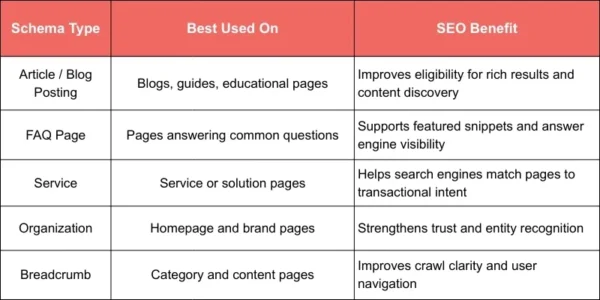
Different pages require different schema types based upon their intent and content purpose. Below, a bullet set helps recount the most suited schema types which are generally employed for on-page optimization:
- Article or Blog Posting schema handling educational content
- FAQ Page schema addressing question-based sections
- Product or Service schema for commercial pages
- Organization schema to back up company identity
- Breadcrumb schema to tie website structure together
Schema Table for On-Page SEO Use Cases
Schema Must Reflect Visible Content Accurately
Structured data must always match what users can see on the page. Marking up information that is missing, misleading, or exaggerated can weaken trust and cause search engines to ignore the schema entirely. Accurate alignment between content and schema reinforces credibility and supports long-term performance.
Schema Enhances On-Page SEO Without Replacing It
Schema markup is not a shortcut to rankings. It works best when layered on top of strong on-page fundamentals like clear structure, intent alignment, and quality content. When used correctly, schema helps search engines understand what you have already optimized, making your pages easier to classify and more competitive in search.
Measuring On-Page SEO Impact on Business Growth
Why Measurement Is Essential for On-Page SEO
On-page SEO doesn’t matter unless it’s measurable. Rankings don’t tell the whole story. A business grows when on-page improvements lead to better engagement, closer alignment with intent, and more purposeful actions–all of which can be measured. Performance measurement is what separates pages that look good from pages that actually grow a business.
Search engines change, user behavior shifts, and competitive landscapes alter. Regular measurement keeps on-page SEO aligned to both algorithmic expectations and business goals.
Key Metrics That Really Matter
Practical metrics are signals of yards gained towards growth, not dummy numbers. After a user hits a page with that on-page SEO, what do they do next? Do they move their mouse towards conversion?
At this point, one set of bullet points will clarify the most relevant metrics related to on-page performance:
- The quality of organic traffic more than the quantity
- Time spent on page and depth of scroll represent engagement index indicators
- Click heat map effectiveness
- Conversion actions like form submissions or inquiries
- Support pages that lead to assisted conversions
- Connecting Changes on Page to Performance Trends
Changes work best observed over time. Revamping content structure, making something clearer, or better intent alignment is bound to see visible shifts in engagement and conversions. Comparing pre and post on-page updates tells you which parts contribute results (not the whole product) and which require further tweaking.
The methodology avoids hypotheses. Decisions are based on facts rather than assumptions, so optimization is more strategic and efficient.
Using Search and Analytics Tools in Tandem
No instrument can deliver a complete picture. Search performance data shows visibility and click behavior, while analytics platforms reveal how users interact with pages. Combined together, these data streams suggest why certain pages grow and others remain stuck in obscurity.
For businesses of all sizes, this integrated view ensures that on-page SEO is related directly to revenue potential, lead quality, and long term scalability.
Measurement Transforms On-Page SEO into a Growth System
When measurement is steady, on-page SEO becomes regular. Pages improve through data, not so much because they follow trends (though they do). Over time, this builds a treasury of solid assets that appreciate in value. This is how on-page SEO graduates from being an activity to fix things quickly into a reliable and stable business growth system.
Common On-Page SEO Mistakes That Limit Business Growth
Instead of Intent, Focusing on Keywords
Still MSIDA is a common on-page mistake that companies make, keywords than the user’s “intention” priority that Page Result is. Fixed phrases to make rankings temporarily led to click-throughs dropping off even in those who do open up your content Higher incidents of linking out show people that reasonable care has been taken with the aspects that you’re pushing to everyone “than normal.” Search engines spot such a mismatch: signal this means poor engagement. Since no one wants to click and read words of no use to them, eventually visibility indeed plummeted.
Ignoring Page Structure and Readability
Even strong content can underperform if it is difficult to read. Blocks of text that are not broken up into paragraphettes, headings which seem dislocated because they are badly placed at best and occasionally imperfect, overly bibliography and footnoting: poor formatting also slightly affects comprehension. In fact, on-page seo need and so for readers efficient page structure which guides users logically through the information will soon be abandoned.
Online reports have confirmed: where readability falls by more than one grade, even a tier-one service sheet’s performance drops off sharply. Growth comes to a stop.
Excessive internal linking, unnatural keyword placement, or repetitive phrasing can signal manipulation. Search engines are designed to detect these patterns. Pages that feel artificial lose trust, which hurts long-term performance.
Overall, one set of bullet points summarizes the most costly mistakes when optimizing pages on-site:
- Optimizing for keywords without addressing intent
- Producing pages with no depth or clarity
- Many poor page structures overwhelm users
- Artificial SEO weaken trust
- Lack of continuing updates updates as content becomes outmoded
- This bullet set is used alone in the section.
- Neglecting Continuous Improvement
On-page SEO is not a one-time task. Pages that are never reviewed or updated slowly lose relevance for the user. Businesses which treat on-page SEO as a static checklist tend to find their performance deteriorates over time.
Avoiding these mistakes ensures on-page SEO supports growth, not detracts from it. When pages are built for comprehension, functionality and trust, they remain valuable long after they’ve been published.
Conclusion:
Because of on-page SEO, this connection exists today between visibility and reality. On the one hand, it helps search engines understand what your content is about; on the other hand, when people come to find this material useful.
Your pages should be built with intent, clarity, and trust in mind: these are the building blocks that underpin Web visibility, especially for businesses–but when you get them right as text-up information all potential searchers arrive armed for action and understanding.
Businesses can count on more than traffic for growth. Engagement, credibility and conversion are all in play. On-page SEO affects them all: either directly or indirectly it shapes how content is read, whether users feel confident taking that next step of action, and what kind–how much information can be made out properly by this experience and how informed they depart into real life at large.
Every professional who’s spent time on site design effectively knows that good health can only be built up gradually from the ground floor. It is impossible to create a lasting website without solid foundations-underpinning all these types of activities, your work will just fall over in time – unless you inject on-page SEO into every root level stroke.
For companies aiming for sustainable growth, on-page SEO is not a choice but rather a strategic investment. It raises the value of content and converts it into an engine that constantly produces visibility, trust and results.
Are you struggling to get more traffic?
Run a free SEO analysis to uncover site issues, competitor gaps, and ranking opportunities.