
1. Why Email Marketing Still Outperforms Other Channels
Email is still a reliable way businesses can consistently generate high sales. It depends on algorithms and rising costs, while social media and paid ads are both vulnerable. However email enables a business to communicate directly with people who have just shown interest. This direct access to customers gives more control over relationship management and reduces reliance upon unpredictable platforms.
Email also drives long-term revenues. Each message that our subscribers receive on their list builds a sense of familiarity, trust and buying intent with us and our product. We’ve found that this method is cheaper than paid acquisition, which often brings visitors who never come back.
The strength of an email strategy converts new buyers, retains existing customers and improves the lifetime value for all relationships. The whole email marketing process is strengthened by an agency.
The agency doesn’t just send out individual messages once in a while, it designs a structured environment to steer customers from initial interest into repeated purchases. With the right approach, email becomes an accurate revenue channel that supports both short-term sales and longer-term growth.
2. Understanding the Real Scope of an Email Marketing Agency
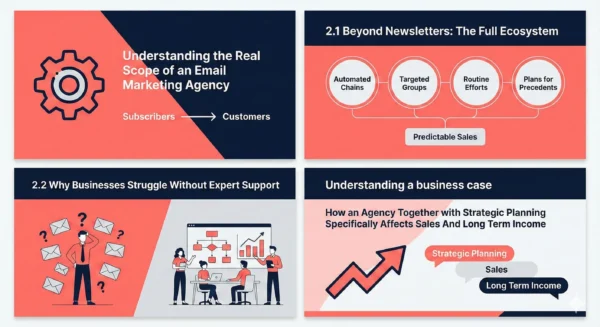
The majority of businesses view email marketing as something special newsletters or promotional showcases. But an agency does far more than this; it builds and manages systems. Its aim is to create an organized communication machine that can always turn subscribers into customers.
2.1 Beyond Newsletters: The Full Ecosystem
An agency designs and supports an e-mail infrastructure that integrates all key features:
- Automated chains of Maximum Profit but Minimal Investment.
- Targeted groups to which we deliver individual changes in the telegram number or code.
- Routine efforts which keep your company before customers ‘eyes, achieving close to the same sales every month.
- Plans for precedents which can bring about better results from one child survey question than another.
These various elements combine to enable sales to be predictable rather than isolated blips.
2.2 Why Businesses Struggle Without Expert Support
The field of email is not easy for businesses to grasp. It needs strategy, design, copywriting, analytics and continuous fine-tuning. General knowledge is of little use in this area; emails often appear irregularly or are timed badly because there is no one else around with specialized experience.
An agency brings order, lucidity, and continuous improvement. It removes the need for guesswork, so that businesses can concentrate on growth while the agency gets down in the trenches to perform all technical work of every message.
Understanding a business case. How Then an Agency Together with Strategic Planning Specifically Affects Sales And Long Term Income.
3. Strategy Development That Aligns with Real Revenue Goals
An email marketing agency should first understand how their client generate incoming and what kinds of customer behavior drive those sales. The goal should be to create a plan that strengthens every stage of the customer journey, from initial interaction right through to repeat purchases.
3.1 Auditing Existing Email Performance
The agency investigates the current email setup to see what works and what hinders sales. This includes examining open rates, click rates, conversions, form completion rates and overall list health. The audit shows problems such as weak onboarding systems, gaps of automation, or poor segmentation. These insights will prove essential for a more powerful revenue model.
3.2 Identifying Growth Opportunities
With the problems identified, the agency can then ferret out opportunities that will give immediate boosts. This could be improving high intent flows, tightening up response times, smoothing off-timing, or honing offers. The thrust always lies in changes which directly influence sales and not in vanity metrics.
3.3 Creating a Long Term Revenue Roadmap
A structured plan is then written up, which can support steadily-increasing income. This roadmap allows for:
- Flow improvements from a stage one subscriber through to an active customer.
- Seasonal campaigns corresponding to consumer buying behavior.
- A framework for testing subject lines, layouts and offers.
- Concrete deadlines for optimization and expansion.
This approach ensures that each email aids in achieving a measurable goal. With a solid strategy in place, the next section tells of how high converting flows can lead to increased sales rapidly and over the long-term.
4. High Converting Email Flows Built for Consistent Sales
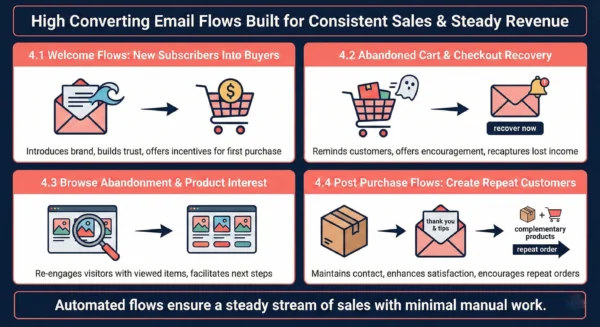
High Converting Email Flows Designed for Steady Revenue Email flows are automated sequences that you can use to nurture your customers at key moments. They work silently in the background and often generate more revenue than normal campaigns. An email marketing agency designs details for each flow to point the customer towards the next behavior it desires, whether that is getting to know the brand or making a purchase.
4.1 Welcome Flows That Turn New Subscribers Into Buyers
The welcome flow introduces the brand and sets the company’s tone in further communications. It builds trust by showing the value right up front, explains benefits and gives new subscribers a reason to make their first purchase. Strong welcome flows increase conversion rates and make a good first impression.
4.2 Abandoned Cart and Checkout Recovery Sequences
Many customers add products to their cart but leave without making the purchase. Recovery flows remedy this behavior by reminding customers of what they left behind and offering encouragement or rewards as needed. These sequences can recapture much that would otherwise be lost income.
4.3 Browse Abandonment and Product Interest Flows
Not every visitor even reaches the cart. Some search through categories or products, then leave. Browse abandonment flows get back in touch with such people by showing them the items they looked at, suggesting alternatives or making it easier to take the next step. These e-mails help turn a casual interest into a planned purchase.
4.4 Post Purchase Flows That Create Repeat Customers
A sale is not the end of the relationship between vendor and customer. Post purchase flows maintain contact, show customers how to use their product and present complementary products. They enhance satisfaction, make it easy to get feedback and increase the likelihood of repeat orders.
With these automated flows in place, the company receives a steady stream of sales without constantly having to do manual work. The next section tells you how your campaigns support this automation and help ensure a predictable monthly income.
5. Campaign Planning That Drives Predictable Monthly Revenue
Remember that campaigns are designed to complement automatic flows and keep the brand visible month after month of those things it handles habits as an individual but in broader terms so as to address the spectators’ new timely messages. These not only push forward sales, but also help to re-engage customers as well. The same applies to interaction. An agency specializing in email marketing lays out a structured campaign plan that is in harmony with sales cycles and business objectives.
5.1 Monthly, Quarterly, and Seasonal Campaign Calendars
A well planned calendar brings order to every task. Monthly campaigns maintain an even keel of engagement, quarterly themes form larger pitches with festival events lend natural urgency. This structure ensures no rush decisions and rumor is managed through communication already set in place.
5.2 Crafting Offers That Fit Customer Psychology
The ideal offer reflects how customers originally chose offers. Agencies create promotions that make eminent sense rather than appear random. Such offers could showcase new arrivals, products going out of stock, gift packs or loyalty points to come out later; being structured in this way encourages action from the customer without sweeping them up altogether.
5.3 Maintaining Brand Storytelling Through Campaigns
Campaigns are more than just discounts. They help shape the brand’s identity, as well through education, inspiration, product descriptions and behind-the scenes news or information. This attention to balance means that even when customers are not yet buying, they can still be kept connected. A business that communicates with value retains long-term interest.
5.4 Balancing Sales With Engagement Content
A robust campaign plan blends sales texts with content open to the public trust. Educational emails, community features, stories from your clients, tips for using products and materials listed from experience all tend to raise involvement and lower boredom. This balance keeps people on the list warm while increasing the opportunity for them to buy when messages about discounts arrive.
6. Professional Email Design That Strengthens Brand Identity
The subscribers’ perception of your brand is closely related to the design of your emails. A clean layout, with information well organized makes reading easier and guides the eye to the important message. An e-mail marketing agency is responsible for the design of a message. A good design like this one increases clarity, builds trust and supports higher conversion rates.
6.1 Mobile First Layouts
Most subscribers open emails on mobile devices. They are mobile first, meaning content displays clean and well-aligned across the smaller screens of smartphones and tablets alike.
This means buttons stay touchable and aren’t fiddly, images load quickly and attention falls onto key information from the start. Thus engagement is higher and drop off rate lower.
6.2 Visual Hierarchy for Clarity
When an e-mail is well put together visually, its structure helps readers navigate smoothly. Headings, sub-headings, images and call-to-actions are laid out to guide the reader’s attention naturally. This makes it easier for subscribers to understand the offer and act quickly.
6.3 Copywriting That Blends Persuasion With Trust
Design & copy always go hand in glove. Clear, honest messaging creates credibility, while persuasive elements help with the “ask”. Agencies also produce copy to explain benefits, y value and what the subscriber should do. Just enough. However, who decides next? The right tone is both confident and deferential.
6.4 Aesthetic Consistency Across the Entire Brand
A consistent look helps to strengthen brand identity. Colors, typography, space and images form a unified style that reflects your business. This in turn establishes some recognition and points to professionalism. Over time, subscribers will come to associate the visual identity with the reliability and quality of your product.
7. Segmentation and Personalization That Boost Conversion Rates
Ways of Segmenting and Personalizing for Better Conversion Rat-Segmentation and personalization allow emails to speak directly to the needs and behaviors of every subscriber. Emails not all of them get the same message, an email marketing agency makes the seeming experience tailored and feels timely. This approach then boosts engagement and translates into higher sales on account of customers receiving content that suits their interests.
7.1 Behavioral Segments
Behavioral segmentation groups subscribers on behavior. This allows emails to reflect their different levels of interest and buying intent.
Useful segments include:
- First time buyers needing guidance and confidence
- Repeated purchasers who respond well to loyalty content
- High intent browsers who have viewed products but not yet purchased
- Subscribers who joined recently and already need an introduction
- Customers who have gone dormant and require reactivation
Each group gets targeted messages in accordance with its place in the buying process.
7.2 Predictive Analytics and Smart Targeting
Predictive tools help us to discover which customers are soon to purchase, likely to lapse or apt to buy various specific types of products. In line with this an agency will take advantage of these ideas and send messages at the best moments for conversion, with content that fits right in. It increases the success rate without bombarding recipients.
7.3 Personalized Content Based on Interest and History
Personalization extends beyond using a name. It means displaying products the subscriber looked at, recommending items based on past purchases and tailoring messages to fit their mating habits. This creates a more personal experience, so that the subscriber feels understood. As a result, response rate goes up and sales will follow soon.
8. Advanced Automation That Increases Sales Without Extra Effort
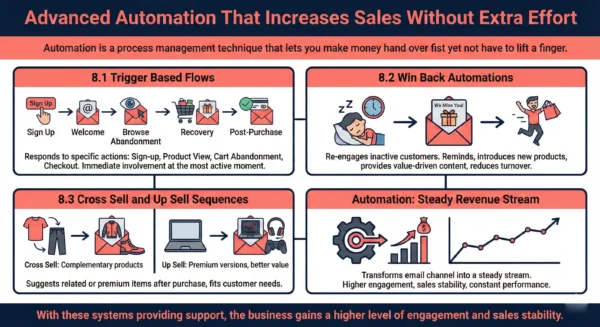
Automation is a process management technique that lets you make money hand over fist yet not have to lift a finger. These automated sequences respond on demand to how customers behave and send prompts leading subscribers towards the next step. A company which specializes in such email marketing household systems as these is very careful that each action should always feel helpful, logical and in time.
8.1 Trigger Based Flows
Instead of sending emails based on arbitrary rules, trigger based systems only activate when a subscriber performs a particular action. Examples of these triggers include signing to the email list, viewing a product’s detail page, leaving a shopping cart full of merchandise unpurchased for too long and completing checkout at all. Every trigger genuinely states one’s interest, and hence automation becomes a very good tool for converting purpose into sales. These streams of email create immediate involvement At exactly the moment the subscriber will be most active.
8.2 Win Back Automations
Not all customers are active. Win back flows re-engage customers which have slipped away. Through these messages the brand makes them remember their own existence, introduces new products, provides value-driven content or gives them good reasons to return. This is a way of lowering turnover among a firm’s customers and extending customer lifetime value of the email list.
8.3 Cross Sell and Up Sell Sequences
Automation is also good for making more sales after the first sale has been completed. Cross sell flows will suggest things that go well with whatever the person has just bought. Up sell flows attempt to get the customer interested in premium versions or packages offering even better value. These sequences are so successful because they now fit in with what the customer was wanting and needing anyway.
The email channel is transformed by advanced automation into a steady revenue stream. With these systems providing support behind them, the business gains a higher level of engagement and sales stability. The next section explains how one should monitor on an ongoing basis the data coming through and constant practice keeps this performance strong over time.
9. Data Monitoring, A/B Testing, and Continuous Optimization
Data-understanding and Real-time business-is the in. Email performance improves when an email marketing agency is always checking out the results of any piece mail plus any flow to keep that pattern bringing constant cash. It helps pinpoint which elements are getting people excited, which are moving items and what needs tweaked.
9.1 Performance Tracking That Reveals True Revenue Impact
Agencies said that open rates, click rates, conversions, and revenue-per-email as well as the flow’s result had clear data to support this. These show which pieces of mail hit the mark just right-and which ones do not. Clear reporting shows where email fits into the business picture.
9.2 Testing Subject Lines, Layouts, Offers, and Timing
A/B testing raises the performance yardstick for each new version of a subject line versus its prototype. Agencies study subject headings to ensure maximum opens, layout for maximum clarity, and details to groom potential purchases; and timing according to customer activity. Gradually through these tests a more sophisticated email system is created which performs better already.
9.3 Using Insights to Improve Each Future Campaign
Data-driven insights help shape future content: if a certain interest is popular, then more articles are supplied in that vein. If a certain form of communication consistently leads sales, it’s part of the normal mix. Optimizing means that emails change with customer behavior instead of remaining static.
By making continuous adjustments while monitoring all conditions, you can keep strong engagement and predictable sales. The email channel every cycle We improve it once again, and make sure that even better quality reaches everyone This is explained in the next section on how agencies can free up manpower for enterprise and reunite entire mailing operations under one manager.
10. Reducing Workload and Eliminating Guesswork for the Business
Email marketing needs consistent planning, writing, design, testing, and analysis. For many businesses, this is too much work in addition to their daily tasks. However, with an email marketing firm handling everything from strategy to execution, the business can keep its eye on growth while qualified professionals focus on all the algebraic problems involved in creating beautiful messages.
10.1 Agencies Handle Strategy, Design, Writing, and Reporting
An agency manages each component of an effective email program. They build the strategy flow charts, produce e-newsletters, conduct case studies to find new topics, write the copy for emails and then send them off to be designed. Throughout all tasks, a thorough comprehension of customer kinds and their spending targets is strictly adhered to. The result is a well-oiled consultative team across the nation – no longer depending on the business’s hand over every tiny detail day in and out.
10.2 Businesses Gain Clarity, Focus, and Saved Time
With a firm in charge of these tasks, you don’t have to wonder anymore what exactly to send and when to send it, or how the results can be improved. The decisions consist of quantitative data rather than guesses. This doesn’t just give clarity, it removes distractions from your path and at the same time provides a ton of time that can be re-allocated for product development, customer service or larger marketing initiatives in general.
11. Conclusion:
If you want your email marketing to be a consistent source of sales you will need good strategy, good design, automation, ongoing optimization the three of those together. And only when you have a comprehensive email marketing structure to back you up and provided by an email marketing agency can you reach that kind of success. Through such means, email changes from mere touches with a customer here and there into an integrated whole system which digs up and feeds long term demand while also offering active support to customers. After all, email in itself is a long-staying customer.
On this foundation one reminder e-mail after another plays its part in guiding customers from first purchase right through their next shopping and onto rebuy. Automated flows pick out important points in the sales process while meticulously planned campaigns maintain a yearlong connection. Segmentation, personalization as well as data-driven suggestions push up this way by helping any message become more relevant and effective.
Over time, businesses achieve predictable returns, develop better customer relationships and save plenty of hard work. Eventually, email becomes one of the chief assets in your marketing mix, the regular column that gently persuades prospects to buy from you again and again. It is predictable, it adapts to the customer behavior and is always ready for another order, regardless of the platform that serves as its vehicle or what changes may come up there.
Are you struggling to get more traffic?
Run a free SEO analysis to uncover site issues, competitor gaps, and ranking opportunities.